Your team has an innovation mandate. Now what?
One Meta research manager called my approach “too playful” for her team of researchers.
Six months later, she’d referred me to five other teams.
That’s what happens when skeptical, analytical people get a framework built for skeptical, analytical people — instead of innovation theater that looks great on a slide deck and fades by the following Monday.












I’m Melissa Dinwiddie, founder of Creative Sandbox Solutions™ and creator of the
framework.
I help VP-level leaders at mid-to-large tech and SaaS companies close the gap between the innovation culture that leadership is demanding and the risk-averse, heads-down reality on the ground.
Innovation isn't a value. It's a practice.
And it can be built — systematically, measurably, without a calendar full of offsites.
In 30 minutes, you’ll know exactly what’s stalling your team’s innovation — and what it would actually take to fix it.

The gap is real. So is the evidence that you can close it.
Here’s the thing about innovation mandates: they almost always come with a people diagnosis attached. “Our team isn't creative.” “They’re too risk-averse.” “They won’t let go of perfectionism.”
That’s not a people problem. That’s an infrastructure problem.
Your people aren’t broken. They’ve never been given a repeatable practice for thinking differently — just a mandate to do it, and a workshop that generated a great day and no lasting change on the Monday after.
I know this because I’ve spent years solving it, specifically with the people most likely to roll their eyes at “go be creative”: researchers, engineers, data scientists, project managers. The most skeptical, evidence-driven teams in the industry.
Years of running programs inside companies like Google, Meta, Salesforce, and Uber — with the researchers, engineers, and analysts everyone else calls 'not creative' — showed me exactly where analytical minds shut down, and what it actually takes to move them. The Create the Impossible™ framework is what I distilled from all of it.
The result? Teams that don’t just feel inspired — they think differently on a Tuesday afternoon six months later. And managers who refer me to five colleagues before the engagement is even over.
“I have already seen my team using these tools in their day-to-day work.”
– Senior UX Research Manager
Meta
“I could see the breakthroughs happening — it was ELECTRIC!”
– Attendee
PMI SF Bay Area PDD
“These were the most fun meetings I’ve attended all year!”
– Research Team Participant
Meta
Not sure where your team’s innovation is getting stuck?
Take the free Innovation Bottleneck Finder. In 5 minutes, you'll identify the specific patterns that are stalling your team's ability to think and move differently — and get a starting point for where to focus first.
Enter your details here to get instant access.
The Create the Impossible™ Framework
Three phases. Built specifically for analytical, skeptical teams — the
ones who’ve sat through innovation workshops before and came
back unchanged.
Play Hard → Make Crap → Learn Fast.

P lay Hard
Your team stops waiting for the perfect idea and starts generating options fast — so decisions get made and momentum builds instead of stalling.

Make Crap
Break the endless polishing cycle that keeps good ideas from ever seeing the light of day.

Learn Fast
Get your team comfortable moving before they have certainty — building the habit of iterating in real time so you find out what works in days, not quarters.
Outcomes: faster decisions · ideas that actually ship · less stagnation · teams willing to take real risks

Ways to work together
From a single high-impact keynote to a year-long culture transformation.
The right fit depends on where your team is and what you’re actually trying to change.

If you want your team to experience what innovation as a practice actually feels like — and walk away with tools they can use immediately:

If you’re ready to build the muscle — and want your managers running experiments independently within 90 days:

Not sure which fits? Start with a 30-minute conversation.

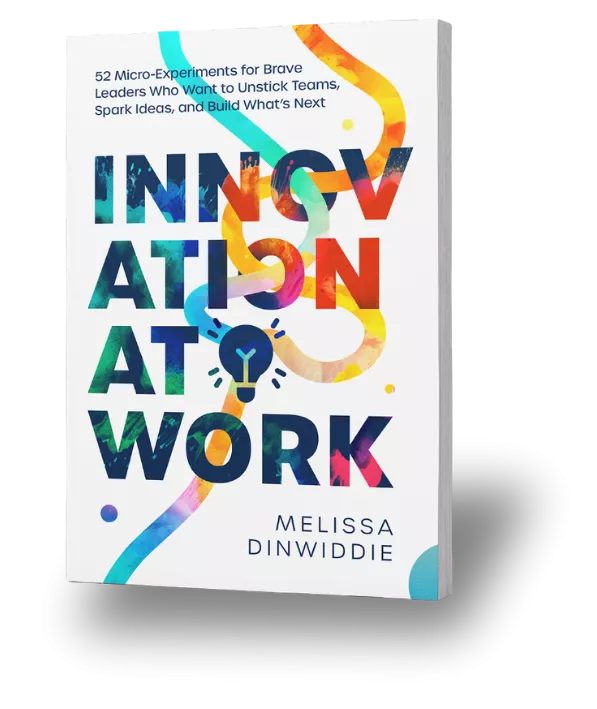
Innovation at Work
52 Micro-Experiments for Brave Leaders Who Want to Unstick Teams, Spark Ideas, and Build What's Next
One copy makes a manager smarter. A shelf of copies starts a culture shift.
This is the same methodology I bring to client engagements — now in a format your managers can run inside meetings that are already happening. Each experiment takes 5–20 minutes. No dedicated “innovation time.” No special equipment. No consultant required.
Think of it as the operating manual for the Tuesday morning when I’m not in the room. In longer engagements, it’s what carries the transformation between sessions — so the work doesn’t stop just because the meeting ended.
Organized by time, problem type, and team context, with facilitation scripts so your managers don’t have to figure out how to introduce an improv exercise to a room full of skeptical engineers on their own.
Ready to close the gap?
Your team has the capacity to think differently. They just need the infrastructure to do it consistently.
Let's talk about where they are, what leadership is expecting, and what it would actually take to move them.
No pitch. Just a real conversation about your innovation mandate. You’ll leave with one clear next step — whether we work together or not.
Prefer to send a note first? Use the contact form.

Let’s Connect