Click to watch (11:42) or scroll down to read more
Hey there, innovation champions!
What Four Strings Taught Me About Permission
Last week I was at music camp, standing behind my upright bass, absolutely certain I was about to embarrass myself.
I was there to take a Walking Bass class — the thing jazz bassists do that always looked like pure magic to me. I’ve been improvising as a singer for years, but without perfect pitch, I never really knew why what I was singing worked. I just sang what sounded right and hoped.
The bass doesn’t let you get away with that.
Here’s a cool thing I learned when I started playing bass: every string is exactly a fifth away from the one next to it. The whole instrument is one repeating pattern. Once I saw that pattern, something shifted that I’d never felt as a singer — I could actually see my options instead of guessing at them.
The day after I got home from camp, I pulled up “Fly Me to the Moon” on an app, slowed it to a crawl, and for the first time ever, walked an actual bassline instead of just hitting root notes. Wobbly. Slow. Absolutely thrilling.
The Secret Isn’t Talent. It’s Constraint.
Here’s what I keep coming back to: the bass didn’t become playable because someone gave me more freedom. It became playable because someone showed me the structure I was working inside of.
I see this exact pattern with teams, constantly. Leaders assume the fix for a stuck team is more freedom — fewer rules, more brainstorming, more “no bad ideas” energy. Sometimes that’s true.
But just as often, the real problem isn’t too little freedom. It’s too much of it.
A team staring down a genuinely open-ended challenge — infinite tools, infinite approaches, no obvious starting point — doesn’t feel liberated. It feels paralyzed. Unlimited options don’t read as opportunity. They read as a wall.
A Quick Note on This Series
Back in December, I shared the first “15-minute meeting opener” I use with teams — the Crappy First Draft Showcase, which tackles perfectionism head-on. If your team’s stuck because ideas feel too rough to share, that one’s still worth running.
This week’s opener is for a different flavor of stuck: not “our ideas aren’t good enough,” but “we have too many good options and can’t move.” Different innovation killer, same 15 minutes.
Steal This: The Constraint Challenge (Experiment #26)
⏱ Time: 15 minutes 👥 Team size: 3–8 people 🏠 Works remotely: Yes
The setup: Take a real, current challenge your team is facing. Add one artificial constraint that has nothing to do with your actual limitations. For example: “Solve this using only free tools.” “Design this for someone who’s never touched the product before.” “You have a team of three, not twelve.”
The work (10 minutes): Design a solution inside the constraint. No exceptions, no “well, technically.” The constraint is the whole point.
The debrief: What did the limit force you to notice that you’d been missing? Did anyone reach for an idea they wouldn’t have considered without it?
That’s it. No materials, no facilitation training, no pulling anyone off their calendar longer than a stand-up already runs.
Why This Works (Especially When a Team Is Drowning in Options)
Constraints don’t shrink creative thinking — they focus it. Every breakthrough I’ve watched happen in a room, from Meta researchers to project managers to healthcare leadership teams, has had a boundary somewhere underneath it. Not a rulebook. A boundary.
When you hand a team an artificial constraint, you’re not making the problem smaller. You’re removing the paralysis of infinite blank-page thinking and replacing it with a door they can actually walk through.
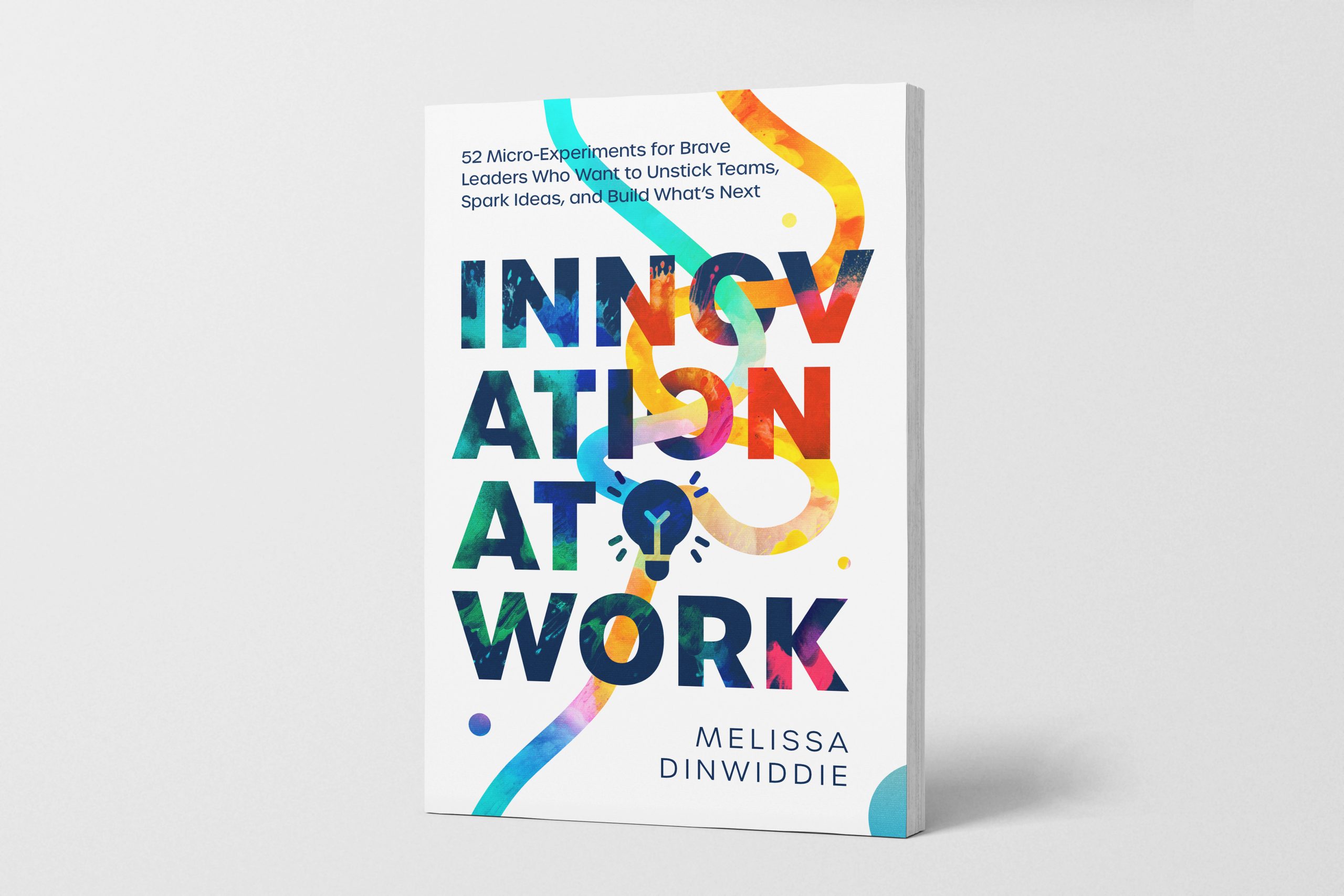
If you want all 52 experiments like this one, grab a copy of Innovation at Work.
And you can also get a special Leadership Edition – available only on my website – which includes an exclusive 5-part “Innovation Leader’s Edge” video series. Everything you need to run your first micro-experiment, get leadership buy-in, and build lasting innovation culture.
If your team has been circling the same “we could do anything” conversation for weeks with nothing to show for it, this is the fifteen minutes that breaks it.
And if what you’re sitting with isn’t one stuck meeting but a whole team, or a whole innovation mandate, that’s a longer conversation — one I’d genuinely love to have with you.