Click to watch (10:24) or scroll down to read more
Hey there, innovation champions!
Open a dictionary to the word “perfectionist,” and you’d have found a picture of 11-year-old me.
My motto in 6th grade: “Life is serious business.”
I was that kid. At every dress-up party — Halloween, birthday parties, school plays — while other kids gleefully chose the goofy, the silly, the delightfully ridiculous, I always chose the elegant. The impeccable. The flawless. A fairy. A princess. A very regal cat.
I was not the first one on the dance floor. I was the one watching, calculating, waiting until I was sure I’d do it right.
It took a lot of work to unlearn that.
The Long Road to “Imperfectionist”
I’ve shared before about the moments where I’ve stumbled, named it out loud, and watched the room relax. The wrong note sung in front of hundreds. The piece of art I planned to paint over that someone asked to buy.
But here’s the part I don’t say as often: imperfectionism is not my native state.
It is a practice.
That’s why we call it that.
The pull toward perfectionism — toward the elegant costume, toward waiting until I’m sure — is still there. I feel it in sessions when I’m tempted to demonstrate something polished instead of messy. I feel it when I’m about to share half-formed thinking and the old voice shows up: not ready yet.
What I’ve learned is this: brave leadership isn’t a personality trait. It’s a daily decision to go first, imperfect, anyway.
The Activity That Taught Me This
There’s a warm-up activity I love to use to open the sessions I facilitate. I call it the Empathy Mirror.
Everyone stands in a circle. One at a time, each person shares a sound and movement combination that expresses how they’re feeling right now — and then everyone else mirrors it back.
I always go first.
And I always go wild.
The sillier, the more ridiculous, the more unguarded I am — the more the room opens up. If I go first with something small and minimal, I have just quietly told everyone in that circle that small and minimal is the ceiling. Nobody will risk going past where the leader went.
But if I throw my whole body into something goofy and unself-conscious? I watch the ceiling rise in real time.
The leader’s behavior is not a suggestion. It is the outer limit of what everyone else feels permitted to do.
This isn’t just true of warm-up activities. It’s true of brainstorms. Of retrospectives. Of how your team responds to a half-formed idea you share in a meeting. Of whether anyone ever admits, out loud, that they don’t know something.
What “Practicing Imperfectionist” Looks Like in Practice
I want to give you something concrete.
Because “model vulnerability” and “be human first” are phrases that sound meaningful and then dissolve into nothing the moment you’re actually in a meeting.
So here’s what I mean, specifically:
It’s the leader who says, mid-meeting, “I don’t actually know if this is right — here’s my half-formed thinking.”
It’s the one who shares a work-in-progress and explicitly names what isn’t working yet.
It’s the one who, when an experiment fails, asks “what did we learn?” before asking “what went wrong?”
None of these are grand gestures. None require a workshop, a consultant, or an offsite. They are small, repeated choices — made in ordinary moments — that accumulate into a culture where people feel safe enough to actually innovate.
Your team is watching you. Not for the speech. For the small move.
The Antidote: 8 Minutes, One Piece of Paper
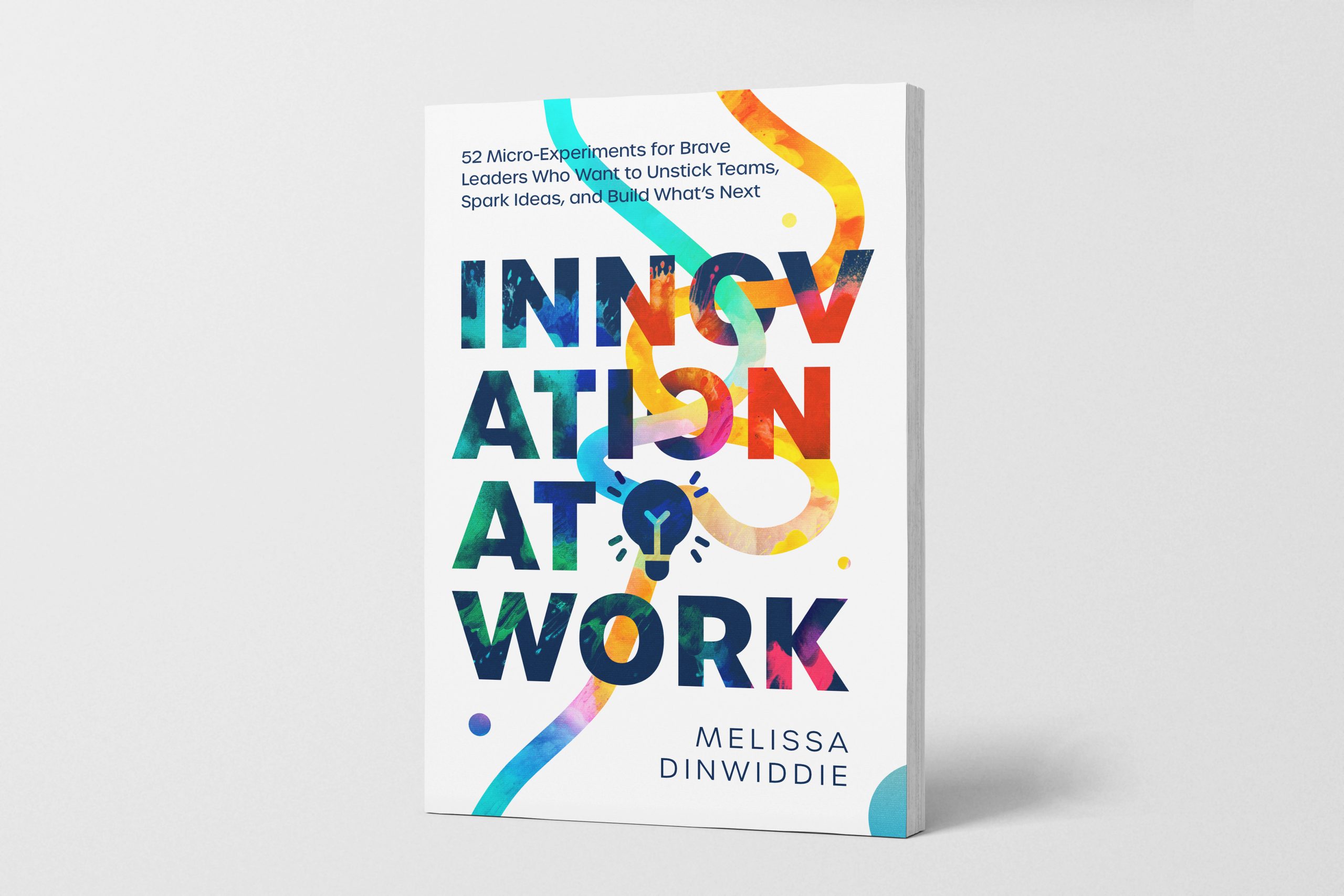
If you recognize yourself anywhere in this — if the impeccable fairy costume resonates a little too closely — here’s a micro-experiment from Innovation at Work that takes 8 minutes and tends to shift something in a room fast.
Experiment #13: The Permission Slip Protocol
Each person writes themselves a permission slip for one specific behavior they’ve been hesitant to try.
🟠 “Permission to share half-formed ideas in meetings.”
🟠 “Permission to question project assumptions.”
🟠 “Permission to suggest a process change.”
Then everyone shares their slip — and gets explicit verbal permission from their colleagues.
The leader goes first.
That last line is the whole thing. When you write and share your own permission slip — when you name out loud the thing you’ve been hesitant to do — you are doing the most powerful facilitation move available to you.
You are raising the ceiling.
Eight minutes. One piece of paper. The full experiment, with facilitation script, remote adaptation, and scale guidelines, is on page 99 of Innovation at Work.
A Note on This Practice
I’m starting to have some of these conversations on the record. More on that soon.
In the meantime: the next time you’re in a room — virtual or physical — and you feel the pull toward the impeccable, the polished, the waiting-until-I’m-sure?
Go first anyway. Imperfect. Unguarded. A little goofy.
Watch what happens to the ceiling.