Hey there, innovation champions!
Your team doesn’t need more alignment meetings. They need one small experiment and permission to start before they’re ready.
Here’s how I know.
The Competition I Almost Didn’t Enter
On Saturday, I stood onstage in a TV studio and told a five-minute story to a room full of judges and fellow speakers.
I placed third in the NSA NorCal Last Story Standing storytelling competition.
That’s not the win I want to tell you about.
The real win was simpler, and honestly more useful to you: I showed up.
Not that long ago, a competition like this would have activated what I call my Comparison Trap gremlin — that inner voice that tells you whatever you make has to be brilliant before you share it with the world. Back when I was a professional artist, I’d flip through calls for entry in the mail, feel that deep yearning pressing against the inside of my ribcage… and then never pick up a pencil. Never make a draft. Never submit a single thing.
The pressure of being judged made it impossible to start. So instead of making something imperfect, I made nothing at all.
The Reframe That Changed Everything
Two years ago, when I saw the call for this same competition, I tried something different.
Instead of focusing on the outcome — one winner advances to regionals! — I asked myself a different question: What do I want to get out of this experience, regardless of where I place?
My answers were immediate:
I wanted a stage-worthy story (and a deadline is the best forcing function I know).
I wanted to perform it in front of a live audience.
This year, with the competition held in person in a TV studio, I added a third: I wanted professional video footage of myself telling it.
I got all three. The placement was a bonus.
And here’s the thing about competitions — they’re completely subjective. This year’s field was strong. If I’d been on the judging panel, I would have given first place to someone who didn’t place at all. That’s how subjective these things are.
Which means the only part of the experience I actually controlled was my own preparation, my own commitment, and my decision to show up.
Why Your Team Keeps Waiting for Certainty (And What It’s Costing You)
I see the same pattern in virtually every analytical team I work with.
Smart people. High standards. Deep expertise. And a quiet, persistent habit of waiting until the conditions are right — until the plan is perfect, the data is conclusive, the stakeholders are aligned — before they’ll take the first step.
It looks like diligence. It feels like prudence. But underneath it, it’s the same thing that kept me from submitting art for years: the belief that starting imperfectly is more dangerous than not starting at all.
The cost isn’t always visible. It shows up as slow decision cycles, innovation initiatives that never quite launch, and teams that are endlessly preparing to create rather than actually creating.
Movement beats certainty. Every time.
Not reckless movement — not “just ship it and hope for the best.” I mean the deliberate choice to run a small, bounded experiment before you have all the answers. To treat uncertainty not as a stop sign, but as the starting condition for discovery.
What One Small Experiment Actually Does
When I work with analytical teams — project managers, researchers, engineers, L&D professionals — I don’t ask them to abandon their systematic thinking. I ask them to apply it differently.
Instead of analyzing the idea, analyze the experiment.
Instead of waiting for alignment on the solution, get alignment on the test.
That shift — from “let’s get this right before we start” to “let’s run this small and see what we learn” — is the engine behind my Create the Impossible™ framework. Play Hard → Make Crap → Learn Fast.
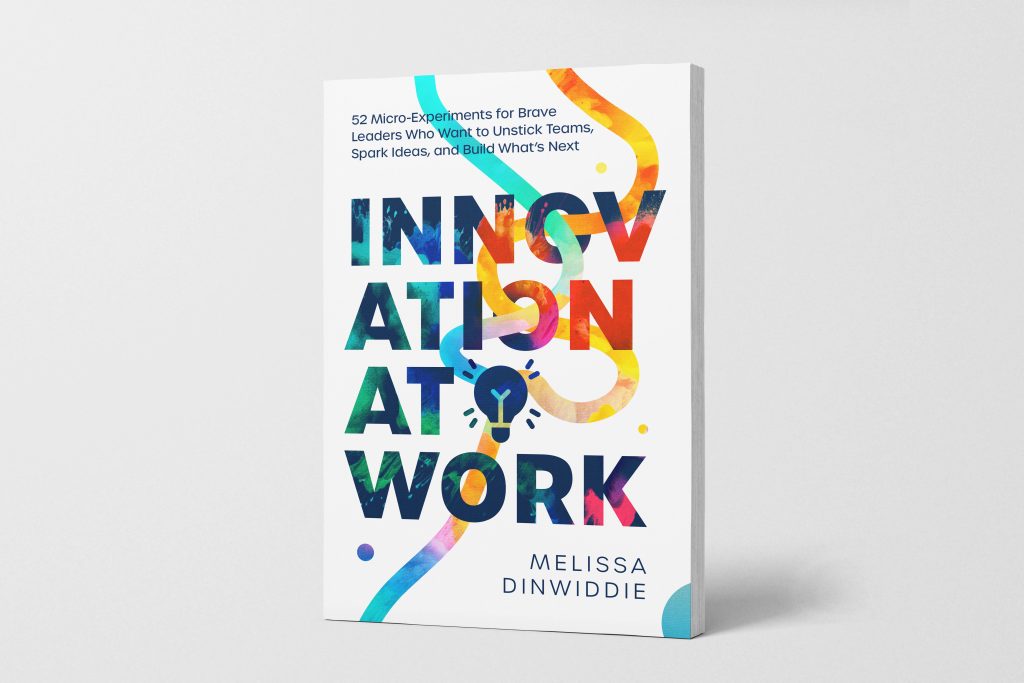
It’s also the premise behind every one of the 52 micro-experiments in my new book, Innovation at Work.
Each experiment is designed to fit inside an existing meeting. Most take 15 minutes or less. None of them require you to pull your team offline, hire a consultant, or overhaul your culture first.
You just have to start.
Speaking of Starting…
The paperback edition of Innovation at Work launches officially on March 10 — six days from now.
But you don’t have to wait.
The Kindle is available right now at launch pricing ($0.99 — going up when the paperback drops). And if you want to read the first 50 pages before you decide, the preview is free.
👉 Download a free preview of Innovation at Work
👉 Grab the Kindle now at launch pricing
If your team has been talking about innovation without actually doing it, this is the small experiment that starts the process. Pick one. Run it this week. See what you learn.
That’s all it takes to begin.
Click here and tell me. What experiment did you try? What surprised you? I want to hear all of it — especially the parts that didn’t go according to plan.