Hey there, innovation champions!
I want to tell you how I actually want you to use my new book. But first, a confession.
A Canvas That Sat in Plastic Wrap for Years
Back when I was making my living as a professional artist, I spent close to a decade almost never making art for myself.
I was trapped in a story that everything I created had to bring in money, had to be “amazing,” had to justify itself. The result? Total paralysis. I couldn’t start anything that didn’t have a client’s name on it.
At one point, I bought a stretched canvas, thinking I’d explore some new media. But that canvas sat on a shelf in my studio, still sealed in its plastic film wrapper. I was so afraid of ruining it that I couldn’t bring myself to take it out of the packaging.
For years.
Then one day, something shifted. I made a conscious decision: today was about process, not product.
I ripped off the plastic. Splashed paint around. Scribbled. Cut up a pair of old flannel pajamas and used acrylics to collage some robots onto the canvas. I can still remember the buzz in my solar plexus as I worked — that unmistakable hum of being fully in the flow.
The result? An unmitigated disaster.
And I didn’t care, because I had so much fun making it.
Here’s what I realized: that “disaster” was just the first layer. It was — to use a term I’d come to build a whole framework around — my crappy first draft.
The Insight That Should’ve Been Obvious
Every piece I’d ever created for a client started with a crappy first draft. Every one. So why had I been operating as if my personal art needed to spring from my fingertips fully formed, like Athena from the head of Zeus?
Give me a break.
And it’s not just art. My keynotes start crappy. The workshops I design start crappy. My first book started crappy. And yes — Innovation at Work started as a crappy first draft, too.
Here’s why this matters to you: your team is doing the same thing I was doing with that canvas. They’re sitting on half-brilliant ideas, keeping them wrapped in plastic, waiting until they’re “ready” to share. Meanwhile, the opportunity window is closing and scrappier competitors are shipping rough concepts and iterating toward gold.
Why I’m Telling You This Now
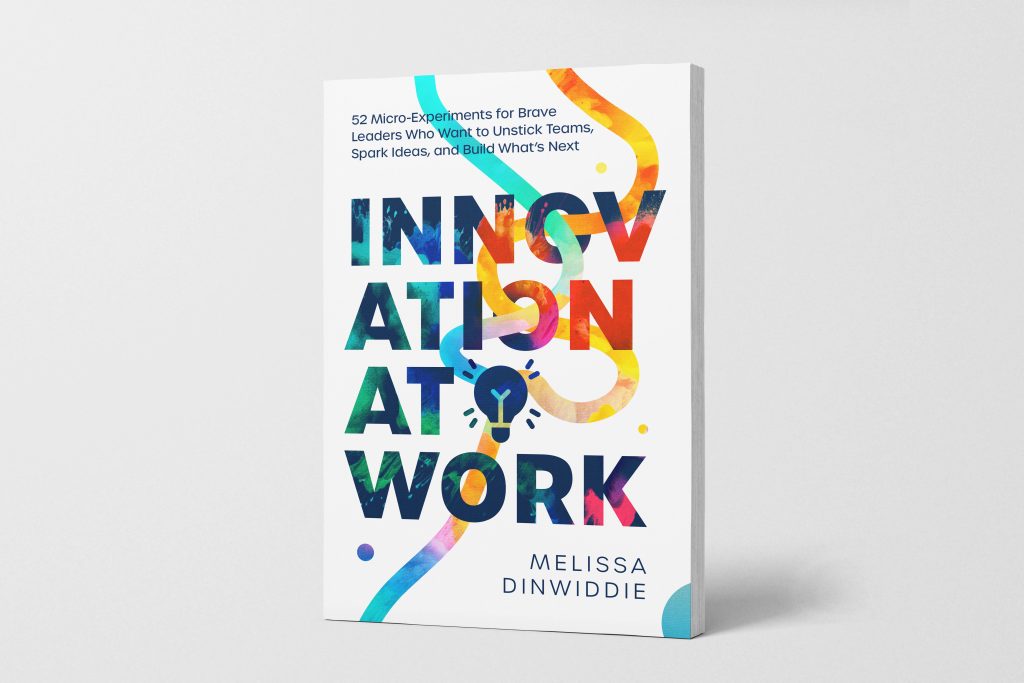
My new book, Innovation at Work: 52 Micro-Experiments for Brave Leaders Who Want to Unstick Teams, Spark Ideas, and Build What’s Next, (soft) launches this Friday. And I want to be really clear about what this book is — and what it isn’t.
It’s not a book you read once and shelve. It’s not meant to inspire you. (Okay, maybe a little.)
It’s a working tool. A field guide you crack open when your team is stuck, when your meeting needs a jolt, when the Q2 planning session is producing the same ideas it produced in Q1.
52 micro-experiments, each designed to run in 5 to 20 minutes. No special materials. No facilitator certification. Just open to a page, read the instructions, and run it with your team.
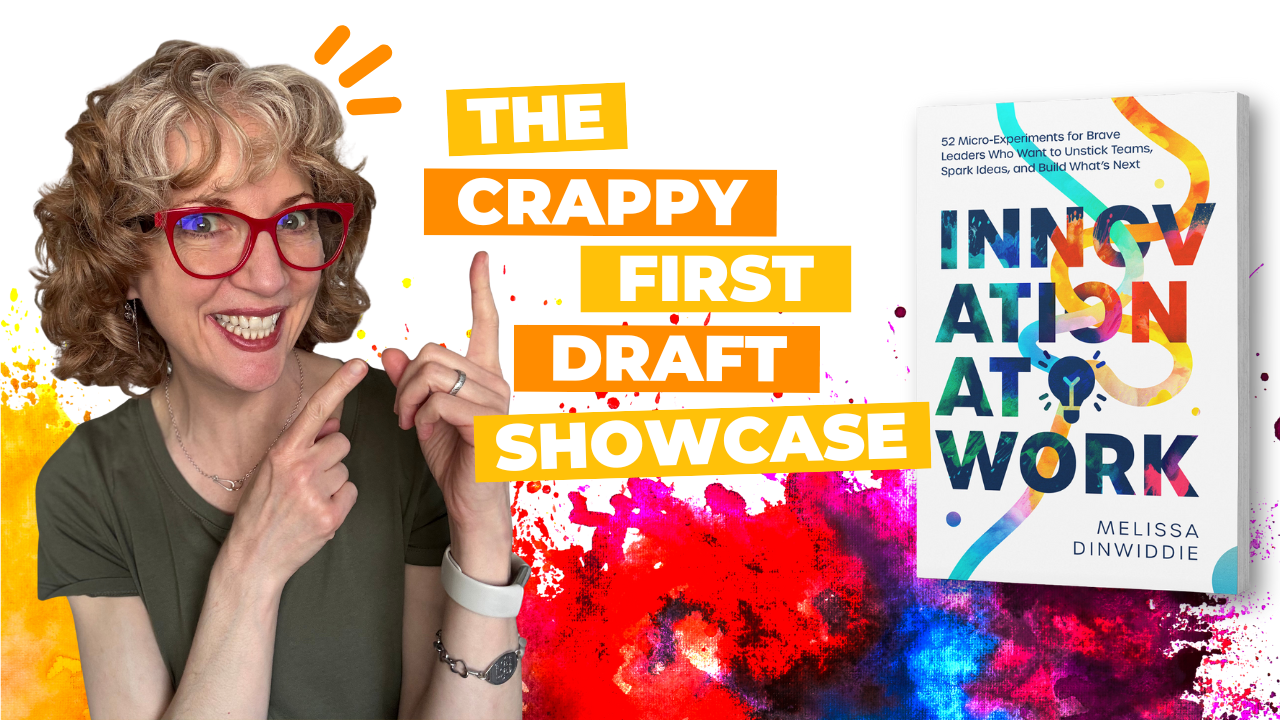
And the very first experiment? It’s called The Crappy First Draft Showcase. Because if your team can’t start ugly, they can’t start at all.
Try It: The Crappy First Draft Showcase (15 Minutes)
Here’s the experiment, straight from the book. Consider this your preview — and your invitation to try it before your next meeting:
Set a 10-minute timer. Have each person create a deliberately terrible first draft of a current deliverable — a slide deck, prototype, brief, wireframe, whatever they’re working on. The goal is to make it intentionally bad. Incomplete thoughts. Rough sketches. Placeholder text that literally says [INSERT BRILLIANT IDEA HERE].
Then celebrate the crappiness. Do a brief show-and-tell where everyone shares their worst work. Praise speed and courage, never quality. “This is beautifully terrible.” “That placeholder text is chef’s kiss — beautifully lazy.”
That’s it. Fifteen minutes.
Why This Works (Even With the Most Analytical Teams)
When everything has to be perfect, nothing gets to be interesting. Your team’s brain switches from “explore” mode to “survive” mode — which is exactly the opposite of what innovation requires.
This experiment tricks teams back into creative exploration by making “terrible” the goal instead of “perfect.” And the shift is immediate.
When I kicked off the PMI San Francisco Bay Area Chapter’s Professional Development Day last year, 125 project and program managers — people whose entire professional identity centers on minimizing risk — experienced this kind of shift firsthand. Within minutes of giving themselves permission to be imperfect, these analytical professionals were generating ideas, making unexpected connections, and collaborating with a buzz of energy that lasted the entire day.
One participant later told me: “Melissa bridges the analytical and the imaginative worlds, helping leaders not only tolerate but thrive in uncertainty.” Another said it was much easier to connect with people for the rest of the day. A third captured the room’s energy in one word: “ELECTRIC.”
If it works for project managers, it’ll work for your team.
How to Use the Book (For Real)
Every experiment in Innovation at Work works like this one — grab-and-go, designed for real constraints, with facilitation scripts so you don’t have to wing it.
But here’s what makes it a system, not just a bag of tricks: the experiments build on each other. The Crappy First Draft Showcase is Phase 1 of a 90-minute Crisis Intervention Protocol for teams that are genuinely stuck. It’s also the entry point for a systematic progression through the book’s four sections (based around my 3-step Create the Impossible™ framework) — Play Hard, Make Crap, Learn Fast, and Create the Impossible™ — that builds innovation muscle over time.
Whether you need emergency triage for a stuck team or a long-term capability-building strategy, the book meets you where you are.
The Book Launches Friday
Innovation at Work soft-launches this Friday, February 13, with special 99-cent pricing on the Kindle edition, only available for a few weeks. Get a free preview here to see the full experiment format, the strategic implementation guides, and the quick reference charts that help you match the right experiment to your team’s specific challenge.
Book buyers will also get access to exclusive bonus materials, including video facilitation walkthroughs and an Innovation Implementation Tracker — everything you need to turn these experiments into lasting culture change.
And if you’re thinking, “I don’t just want the book — I want to bring this to my whole team at scale,” let’s talk. I work with analytical teams to build systematic innovation capabilities — often starting with a keynote or workshop that creates the kind of shift those 125 project managers experienced. A 30-minute Innovation Strategy Session is a good place to start.
Stay curious, stay playful, and keep creating the impossible!
In the meantime, try the Crappy First Draft Showcase this week. Then send me a message and tell me what happened. I genuinely want to know.
Next week: a peek inside Innovation at Work, and how to use the book.