Hey there, innovation champions!
A while back, I was on a Zoom call with a VP at a local tech company.
It wasn’t a sales call — just a customer research conversation. I wanted to understand what was getting in the way of innovation for leaders like her.
She told me her organization had recently done some leadership training. I asked what it was like.
“Honestly? The best thing about it was how lightweight it was,” she said.
I asked what “lightweight” meant to her.
“The biggest problem is we are moving so fast that for someone to step out of their role to do a week-long course would be devastating. We struggle just when someone’s out on vacation, because we don’t have enough resilience or redundancy to navigate.”
And then she said something I haven’t stopped thinking about since.
“If we could download skills, the way Neo gets Kung Fu downloaded in about 30 seconds in The Matrix — that would be ideal!”
I laughed. I wished I had that power. (Though if I did, I’d probably never get to go on vacation either.)
But it also crystallized something for me.
The Objection That Isn’t About Money
If you’re a leader responsible for your team’s innovation capability, you’ve probably felt this tension.
The training budget exists. The mandate to innovate is real. But pulling people out of their regular work — even for a few hours — feels like it costs more than it’s worth.
Deadlines don’t pause for workshops. Customers don’t care about offsite schedules. And in fast-moving organizations, the opportunity cost of “away time” is genuinely high.
I used to think the main objection I’d hear from prospects was money. It’s not. It’s time.
And here’s the thing: that VP wasn’t being difficult or resistant to growth. She was being honest. Her team was genuinely stretched. The old model of pull-everyone-offline-for-a-training just didn’t fit her reality.
She needed something different. So I started asking myself: what’s the next best thing to a skill download?
Why I Wrote a Book of Experiments (Not a Book of Answers)
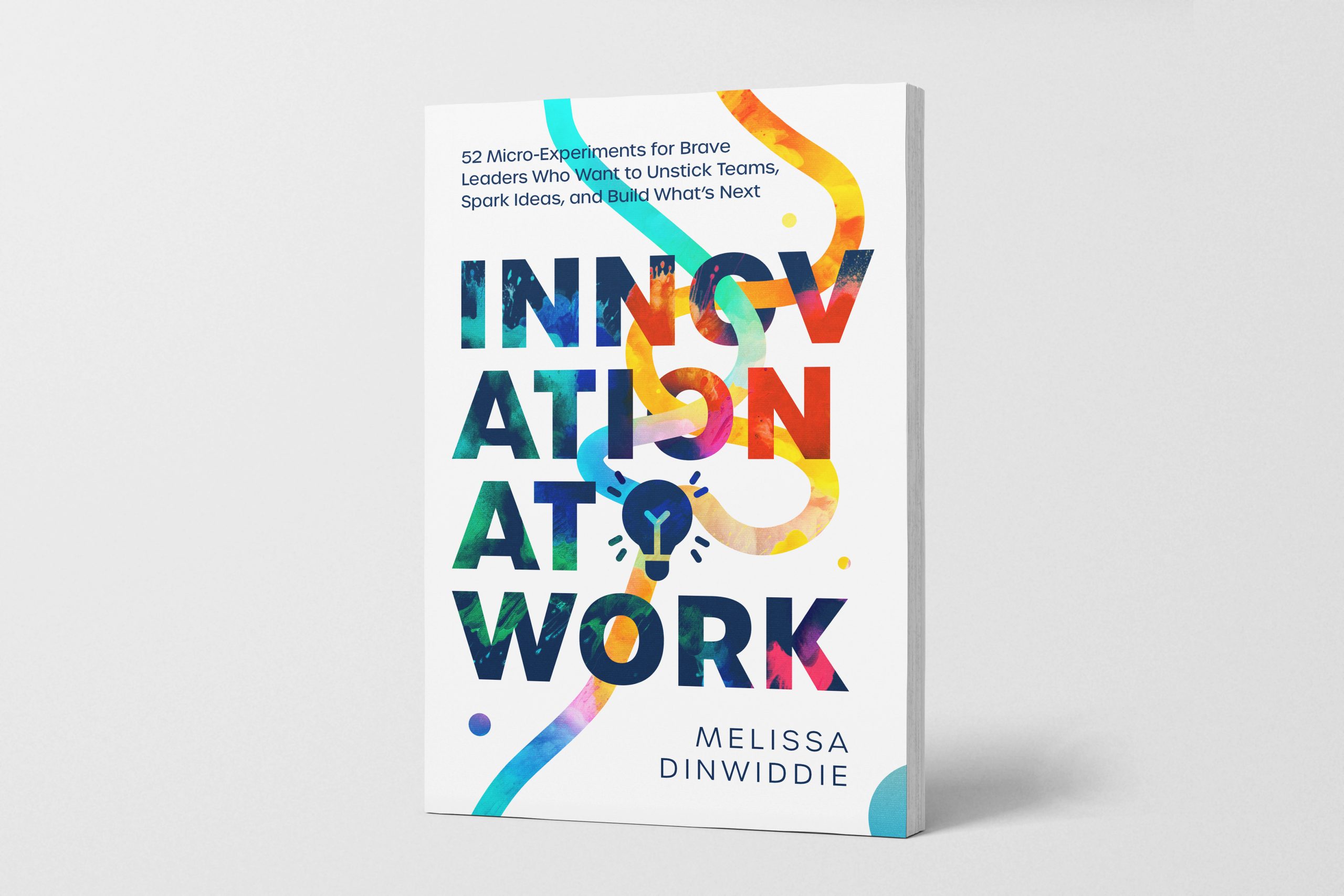
That question became the seed for Innovation at Work: 52 Micro-Experiments for Brave Leaders Who Want to Unstick Teams, Spark Ideas, and Build What’s Next.
I could have written a book full of frameworks, case studies, and implementation roadmaps. That’s what most business books do.
Instead, I wrote a toolkit.
Most of the 52 experiments take less than 20 minutes. Many take less than 10. They’re designed to run inside existing meetings — sprint planning, retrospectives, weekly standups, project reviews. No separate event to schedule. No one pulled away from their desk.
The idea is dead simple: instead of interrupting work to build innovation capability, you build it through the work.
Let me give you an example of what I mean.
What a Micro-Experiment Actually Looks Like
Experiment #1 is called the Crappy First Draft Showcase.
Set a 10-minute timer. Ask each person on your team to create a deliberately terrible first draft of something they’re currently working on — a slide deck, a prototype brief, a wireframe, a process doc. The goal is to make it intentionally bad: incomplete thoughts, rough sketches, placeholder text.
Then have everyone share their worst work in a brief show-and-tell.
That’s it. The whole thing runs in 15–20 minutes.
Here’s why it works: when everything has to be perfect, teams freeze. The brain switches from “explore” mode to “survive” mode — which is exactly the opposite of what innovation needs. This experiment flips the switch by making terrible the goal instead of perfect.
Success looks like this: within a couple of weeks, team members start sharing work-in-progress without being asked. Ideas surface earlier in development cycles. The phrase “it’s not ready yet” starts getting replaced with “here’s what I’m thinking.”
From a 20-minute meeting exercise.
That’s the whole bet behind the book: small, deliberate experiments compound into real culture change — without requiring anyone to go on a retreat.
The Pattern I Keep Seeing
When I talk with leaders at organizations like Google, Meta, and Salesforce — and at engineering, HR, and project management teams across the country — I hear the same frustration underneath different words.
It’s not “we can’t innovate.” It’s “we can’t afford to stop long enough to learn how.”
That’s a solvable problem. Just not with the solutions most organizations have been reaching for.
The 52 experiments in Innovation at Work are organized around my Create the Impossible™ framework — Play Hard → Make Crap → Learn Fast — but you don’t need to understand the framework to use the book. You just need 5–20 minutes and a willingness to try something different.
One experiment per week. That’s all.
By the end of a quarter, your team will be sharing half-formed ideas faster, iterating sooner, and building the kind of psychological safety that makes real innovation possible — not because you mandated a culture change, but because you practiced your way into one.
Not a Matrix Download. But Pretty Close.
I still can’t give my clients a 30-second skill download.
But I can give them 52 experiments that take less time than most status update meetings — and that build innovation capability week by week, inside the work that’s already happening.
That’s what the VP on that Zoom call needed. And if your team is stretched too thin for another “innovation initiative,” it might be what you need too.
Innovation at Work is available now. Grab the paperback or Kindle edition at innovationatworkbook.com/amazon, or download the first 50 pages free at innovationatworkbook.com/preview.
If you’re thinking about bulk orders for your leadership team, visit innovationatworkbook.com/teams — or just hit reply and tell me what you’re working with. I’m happy to help you figure out the best fit.