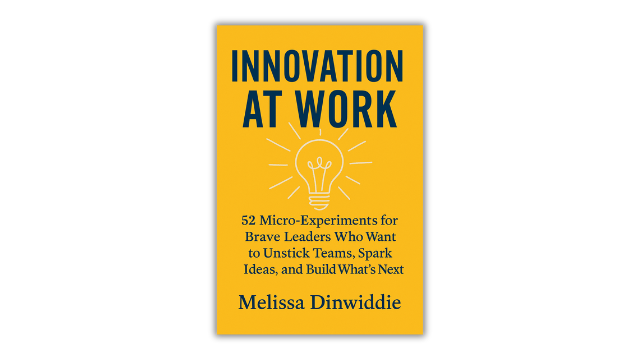
Quick note: No video this week, as I’m head-down working on my second book, Innovation at Work. I’ve cleared my calendar to devote every spare minute to book production, which meant making some hard choices!
Plus a death in the family has thrown an added curveball into the mix. I’ll be out of state for the funeral for a few days.
Watch for videos to return in a few weeks. In the meantime, enjoy this week’s article!

Hey there, innovation champions!
Imagine that your team just completed another innovation session. Everyone’s energized, the walls are covered with ideas, and there’s genuine excitement about breakthrough possibilities.
Three months later? The same bottlenecks persist. The same communication gaps slow progress. The brilliant insights from that session never made it into daily operations.
Here’s the uncomfortable truth: Most innovation work fails not because the ideas are bad, but because it focuses on generating solutions instead of removing the barriers that prevent teams from innovating naturally.
This is the multi-billion dollar innovation theater problem—initiatives that create the feeling of progress while the real innovation killers remain completely untouched.
The Innovation Paradox That’s Killing Your Competitive Edge
The more pressure organizations put on “innovation,” the less actual innovation happens.
Why? When stakes feel highest, teams default to their safest behaviors. They stick to proven processes, avoid “risky” ideas, and create busy work that feels innovative but sidesteps the psychological risk-taking that real breakthroughs require.
According to Gallup’s research, disengaged employees cost the global economy $438 billion in lost productivity annually. But the innovation penalty runs deeper—breakthrough insights that never get implemented, communication gaps that kill cross-functional solutions, and talented employees who disengage because their creative contributions can’t break through systematic barriers.
The Real Innovation Killers (And They’re Not What You Think)
Through my work with teams across tech companies, I’ve identified the four predictable patterns that kill breakthrough thinking before it can emerge:
The Perfectionism Trap: Teams delay sharing ideas until they’re “perfect,” missing market windows while competitors ship “good enough” solutions and iterate based on real feedback.
The Communication Gap: Functional expertise creates tunnel vision. Engineers can’t communicate with designers. Product teams can’t understand research insights. Brilliant ideas die in translation between departments.
Analysis Paralysis: Teams generate lots of ideas but lack systematic methods for rapid testing, leading to endless debate about theoretical solutions instead of real-world validation.
Creative Invisibility: Organizations hire creative, innovative people—then bury their breakthrough thinking under processes designed for predictable work.
What Actually Works: The Meta Breakthrough
Let me share a real example from my communication work that reveals how innovation really happens. A research manager at Meta told me, “We don’t have time for games.” Her team was brilliant—they’d developed UX insights that could transform product development. But their breakthrough insights where gathering dust instead of having the impact they deserved.
The problem wasn’t lack of innovation. It was communication barriers that made innovation invisible.
I started by teaching them “yes, and…” principles—how to validate others’ ideas rather than instantly dismissing them. We practiced finding the positive within negative feedback and explored exercises in seeing multiple sides of complex issues. The perspective-taking and translation skills were just one piece of a comprehensive “communicating for influence” program.
The shift was immediate. After our first session together, the team and manager could already see the value. They began changing their behaviors, developing a shared language for collaboration, and finding new ways to communicate technical insights in terms of product impact.
That manager started recommending me to her colleagues before we’d even finished the pilot program. The transformation scaled across multiple teams over six months—not because we generated new ideas, but because we systematically removed the specific barriers preventing breakthrough thinking from spreading throughout the organization.
The Science Behind Systematic Creativity
Micro-interventions work where elaborate programs struggle for a neurological reason: perfectionism activates the brain’s threat-detection system, shutting down the networks responsible for creative thinking.
When teams operate in what neuroscientists call “explore mode”—the mental state we naturally enter during structured play—they generate significantly more novel solutions and make unexpected connections between previously unrelated concepts.
The breakthrough happens when you systematically remove friction rather than just adding more brainstorming sessions.
Your Innovation Reality Check
Ask yourself these questions about your team’s creative capacity:
- How often do your best ideas actually make it into implementation?
- Are brilliant insights trapped in individual expertise instead of becoming organizational knowledge?
- When facing new challenges, do people suggest experiments or default to familiar approaches?
- How effectively do breakthrough insights travel between departments and functions?
If you’re honest, most teams have far more creative capacity than they can access through current systems. The problem isn’t idea generation—it’s systematic barrier removal.
What’s Coming Next
Real innovation culture happens when you combine the right systematic practices with comprehensive culture change. Neither quick fixes nor standalone workshops create lasting transformation—but the right strategic approach can unlock breakthrough thinking across entire organizations.
Over the next four weeks, I’ll share the framework that helps teams move from innovation theater to systematic breakthrough creation:
- Week 2: The neuroscience of psychological safety and why breakthrough thinking requires permission to explore
- Week 3: Why your brain needs permission to make crap (and how productive failure becomes competitive advantage)
- Week 4: How teams learn fast by turning every failure into competitive intelligence
- Week 5: Putting it all together—the Create the Impossible™ roadmap for systematic innovation
Because here’s the thing: Your team already has way more creative capacity than you might realize. The question isn’t whether innovation is possible—it’s whether you have the strategic method to unlock it consistently.
Ready to transform your team’s innovation capability from theater to systematic competitive advantage? My forthcoming book Innovation at Work: 52 Micro-Experiments for Brave Leaders Who Want to Unstick Teams, Spark Ideas, and Build What’s Next provides practical tools for unlocking creative capacity. Join the early access list for behind-the-scenes insights and preview content.