
💡 Quick favor! My new book Innovation at Work is coming soon, and I need your help choosing the cover. 🎉
Two designs are in the running, and I’d love your vote.
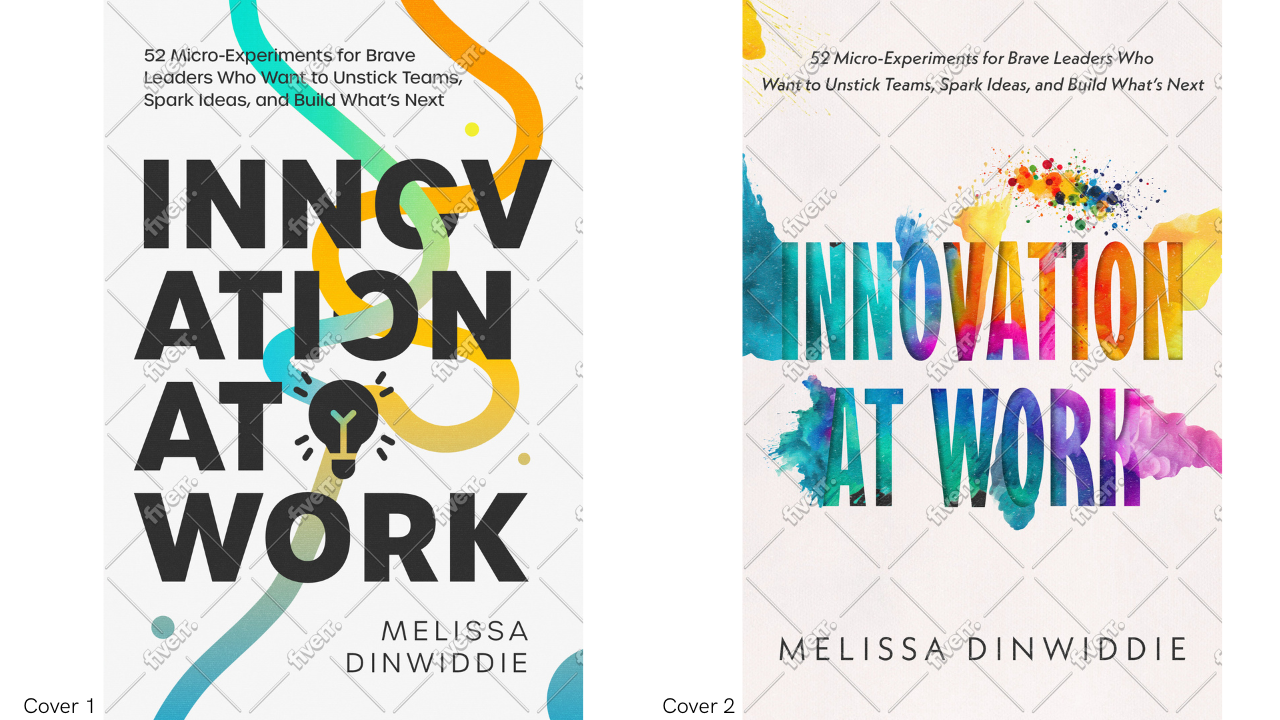
👉 Vote in this quick LinkedIn poll
And if you’d like to share why you prefer one over the other, reply here or drop your thoughts in the comments on LinkedIn. Your feedback will help shape the look of the book before it makes its way into the world.
Quick note: No video this week, as I’m in Alaska! I’m delivering the closing keynote at the Northwest Human Resources Management Association conference in Anchorage.
Then when I get home, I’ll be head-down, working on my second book, Innovation at Work. I’ve cleared my calendar to devote every spare minute to book production, which meant making some hard choices!
Watch for videos to return in a few weeks. In the meantime, enjoy this week’s article!
Hey there, innovation champions!
Here’s a scene that happened at Google in 2003: Executives are sitting around a conference table discussing whether to acquire a photo tool called Picasa. But the CEO isn’t paying attention to the agenda. Instead, he’s completely absorbed by a satellite mapping tool, so excited that he interrupts the meeting to show everyone else.
The entire meeting gets derailed as all the executives abandon their agenda to start playing with and exploring this mapping software.
That moment of unscripted curiosity in an executive boardroom is now legend at Google—it accidentally created Google Maps, one of the world’s most-used platforms worth billions in ad revenue.
This is “Play Hard” in action: embracing experimentation and curiosity as strategic business tools, not distractions.
The Psychological Safety Revolution
Here’s what most leaders don’t understand: innovation isn’t a creativity problem. It’s a safety problem.
When teams feel psychologically safe—when they know they won’t be punished for intelligent risks or half-formed ideas—they naturally access the cognitive networks responsible for breakthrough thinking. But when people worry about looking stupid or making mistakes, their brains literally shut down creative processing and shift into threat-detection mode.
This explains why the most technically brilliant teams often produce the most incremental solutions. It’s not because they lack creativity—it’s because they lack permission to access it.
What I Learned About Play From a Skeptical Meta Manager
Let me tell you about a research manager at Meta who completely changed my understanding of what “play” means in a business context.
When I first suggested running some interactive exercises with her team, she was direct: “We don’t have time for games.” Her researchers had developed algorithmic insights that could transform product development, but those insights were trapped because product teams couldn’t understand the research.
But here’s what happened next. We ran a number of activities focused on perspective-taking and communication translation—exercises that felt playful but had serious strategic purpose.
Within ninety minutes, the researchers discovered how to communicate technical insights in terms that product teams could actually use. After two sessions, the team had a shared language, and behaviors were beginning to change.
The breakthrough wasn’t the “game”—it was that playful exploration created the psychological conditions where breakthrough thinking could emerge. Those two sessions turned into six months of expanded work across multiple teams.
The Neuroscience of Strategic Exploration
When teams operate in what researchers call “explore mode”—the mental state we naturally enter during structured play—something fascinating happens in the brain. The networks responsible for creative connection-making become more active while the systems that create rigid thinking patterns relax their grip.
This is why many breakthrough solutions emerge during informal conversations, walking meetings, or seemingly “unproductive” exploration sessions. The brain needs permission to wander before it can discover unexpected connections.
But here’s the key: this isn’t about frivolous fun. It’s about creating the conditions where your team’s collective intelligence can actually function.
When Play Becomes Competitive Advantage
The most innovative companies understand this intuitively. They build play into their strategic processes:
Atlassian’s ShipIt Days: Teams get 24 hours to work on anything they want. These “playful” sessions have generated hundreds of product features and process improvements that never would have emerged through traditional planning cycles.
3M’s 15% culture: Engineers are encouraged to spend time on independent, experimental projects. This systematic approach to curiosity has led to breakthrough products from Post-it® Notes to medical adhesives.
Amazon’s “two-pizza team” principle: Small teams with permission to experiment rapidly can outmaneuver larger, more structured competitors precisely because they maintain the psychological agility that bureaucracy kills.
The Permission Problem
Most teams are sitting on massive creative capacity they can’t access because no one has explicitly said “yes, you’re allowed to explore this.”
That’s why one of my favorite team interventions is what I call the “Permission Slip Protocol.” Team members write themselves permission for specific behaviors they want to try but feel uncertain about:
- “Permission to question project assumptions”
- “Permission to suggest completely different approaches”
- “Permission to share ideas before they’re fully formed”
Then the team gives each other explicit verbal permission. It sounds almost silly, but removing psychological barriers often unlocks capabilities that were there all along.
Your Team’s Play Hard Reality Check
Ask yourself:
- When did your team last try something completely new without knowing if it would work?
- How often do your best insights come from planned brainstorming versus unexpected conversations?
- What percentage of team time is spent exploring possibilities versus executing predetermined plans?
If your team defaults to execution and planning rather than exploration and experimentation, you’re probably missing breakthrough opportunities that only emerge through strategic play.
The Create the Impossible™ Foundation
Play Hard is the first principle of my Create the Impossible™ framework because everything else depends on it. You can’t embrace productive failure (Make Crap) if teams don’t feel safe to experiment. You can’t accelerate learning cycles (Learn Fast) if people are afraid to share what they discover.
But when teams genuinely embrace curiosity and experimentation as strategic tools, they create the foundation where systematic innovation becomes possible.
What’s Coming Next Week
Next week, I’ll show you how teams move from exploration to execution through the second principle: Make Crap. Because psychological safety is just the beginning—the real breakthrough happens when teams learn to fail productively and turn imperfect attempts into competitive intelligence.
The goal isn’t to play for its own sake. It’s to create the conditions where your team’s best thinking can actually emerge and evolve.
Ready to help your team unlock their innovation capacity through strategic play? My forthcoming book Innovation at Work: 52 Micro-Experiments for Brave Leaders provides the exact methods for building psychological safety that drives performance. Join the early access list for insights and preview content.