Click to watch (13:17) or scroll down to read more
Hey there, innovation champions!
The Buzzer Goes Off
I’m going to take you back to 2014 or so. I’m standing in a line at my first improv performance class, waiting for my turn, watching everyone ahead of me step up to do a scene with a partner.
Simple enough — except for one rule: you cannot use the letter S.
What?!
As I got closer to the front, my heart rate climbed. My mouth went dry. I rehearsed every possible sentence opener in my head, trying to find the S-free ones.
And the moment I opened my mouth?
Third word. S.
Buzz.
Out before I’d barely begun.
The Reframe That Changed Everything
I won’t pretend I wasn’t embarrassed. I was.
But then our instructor gathered us up and asked a question: “Why do you think I had you play this game?”
People offered answers. “To practice thinking on our feet.” “To get comfortable with constraints.”
Close — but not quite.
Finally he said: “Look. It’s not about whether your team wins or loses. The audience is here to be entertained. Your job is not to WIN. Your job is to give the audience a good time.”
And something cracked open for me.
Every competitive improv game I’d found stressful — suddenly looked completely different. I hadn’t been failing at the game. I’d been playing the wrong game entirely.
That’s the moment I understood what “Learn Fast” actually means.
What “Learn Fast” Is Not
“Fail fast” has become one of those phrases that sounds useful and means almost nothing anymore.
Most teams hear it as permission to be sloppy, or as a slightly cheerful way of saying “your experiment didn’t work, better luck next time.”
What it’s actually pointing at is something more specific: the ability to extract useful signal from every attempt — including the ones that don’t go the way you planned.
The improv instructor wasn’t celebrating my buzzer moment. He was giving me the frame to learn from it immediately, without needing to drown in embarrassment first.
That’s what changes everything for teams. Not whether they fail. But how fast they can move from “that didn’t work” to “here’s what we now know.”
The Real-Time Iteration Loop
I run a civic engagement group, and I’m the lead facilitator for our new member orientations.
Every single session, I’m watching the room. Reading the energy. Noticing what lands and what falls flat. Adjusting the plan — sometimes in the middle of it.
This is Learn Fast in action. Not a post-mortem. Not a quarterly retrospective. A continuous, real-time feedback loop that makes each iteration better than the last.
And then there was last month.
A participant with very strong feelings about one of our tactics completely hijacked the discussion. I didn’t redirect it skillfully. The conversation spun. And a few days later, we got an email from another participant saying she wouldn’t be joining our group — because that same hijacking participant had followed her out the door and continued her rant, and the whole experience had soured her on us.
Ugh.
Here’s the thing though: I knew almost immediately that I’d lost control of the room. I felt it in real time. And the email that came later wasn’t a surprise — it was confirmation of what I’d already sensed.
The question wasn’t whether I’d fumbled it. (I had.) The question was: what do I now know that I didn’t know before?
Two things became immediately clear:
One — whoever facilitates these sessions needs sharper skills for redirecting strong personalities without shutting them down.
Two — this particular fumble gave us an opening to follow up with the woman who left, to empathize, to offer a direct conversation with me and our membership lead. A repair that wouldn’t have been possible if we hadn’t been paying close attention.
The mistake became the roadmap.
The Difference Between Stuck Teams and Moving Teams
I’ve worked with a lot of analytical teams — project managers, engineers, UX researchers, data scientists. The ones who get stuck in analysis paralysis tend to share a pattern: they’re trying to get it right before they move.
The teams that move — and keep moving — have learned something different. They’ve learned that certainty is not a prerequisite for action. That a rough draft run teaches you more than a perfect plan on paper. That the information you need to get better almost always lives on the other side of doing the thing, not before it.
Marie Spark, Strategic Advisor at PMI SF Bay Area, saw this shift happen live in a room of 125 project managers:
“I could see the breakthroughs happening — it was ELECTRIC! Her approach proves that creative innovation activities aren’t ‘too woo woo’ for analytical teams.”
These were left-brained professionals trained to eliminate risk. And within 45 minutes, they were extracting real learning from messy, unpolished, on-the-fly experiments.
Because the frame had shifted: the goal wasn’t to get it right. The goal was to get better at getting better.
The 52-Week Muscle
Learn Fast is a muscle. And like any muscle, it atrophies when you don’t use it — and strengthens when you work it consistently.
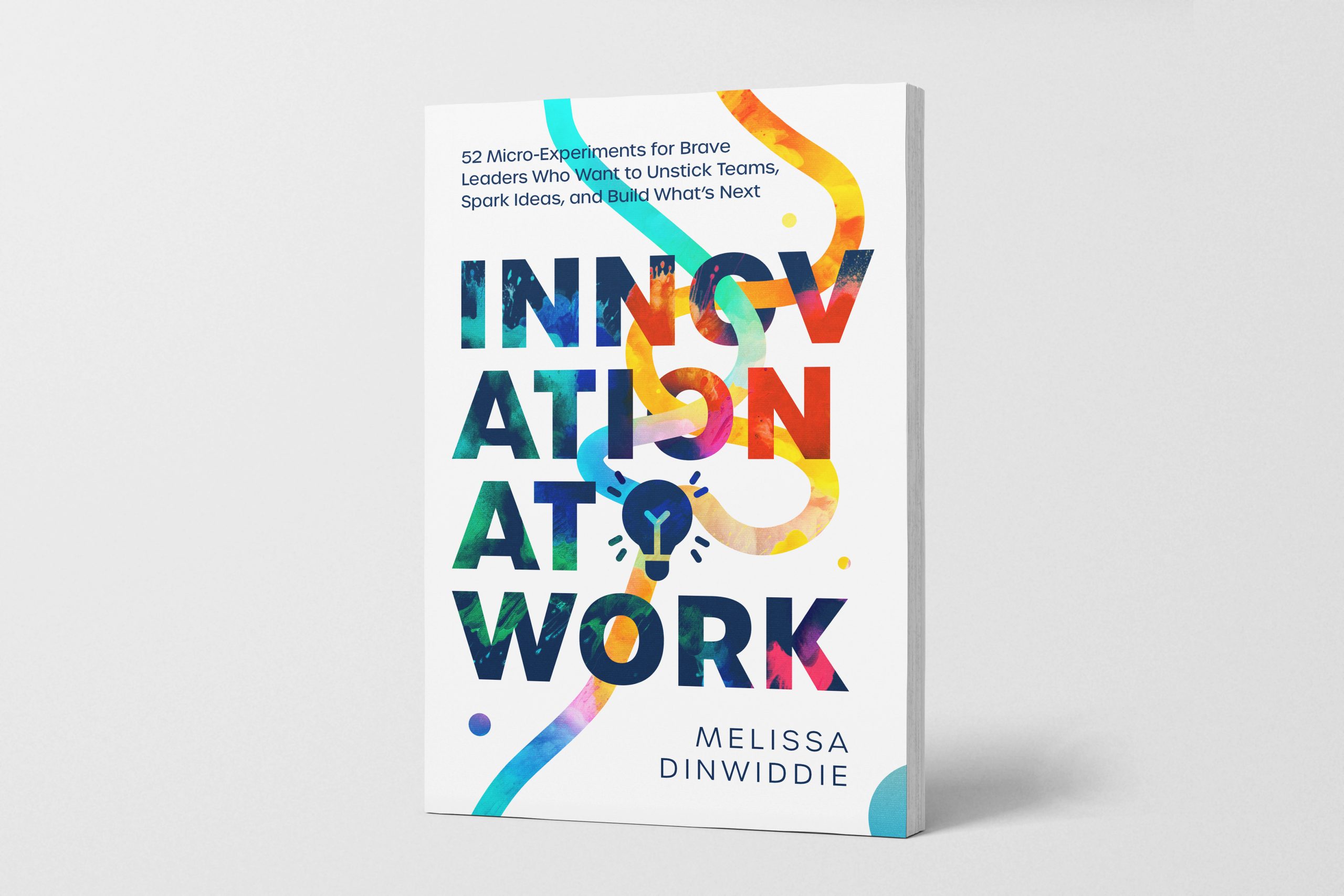
That’s exactly why I designed Innovation at Work as 52 micro-experiments rather than a framework to read and file away. Each experiment is a rep. Done weekly, they build the kind of iterative fluency that turns “fail fast” from a bumper sticker into an actual operating principle.
One experiment from the book worth trying this week: The Pre-Mortem. Before your next project kicks off, spend 15 minutes imagining it’s three months from now and the project failed spectacularly. What went wrong? This isn’t pessimism — it’s Learn Fast thinking applied before the fact. You surface the signals to watch for now, so you can iterate before the stakes are high.
The Invitation
If you’re leading a team that’s stuck waiting for certainty before they move — let’s talk about what it would take to change that.
Book a complimentary Innovation Strategy Session →
Or if you want to start smaller: grab a copy of Innovation at Work and run the Pre-Mortem with your team this week. Then click here and tell me what happened.