
Click to watch (08:12) or scroll down to read more
Hey there, innovation champions!
Here’s something that might reframe how you think about your entire organization’s capacity for innovation:
The people most likely to drive real breakthroughs aren’t the ones in your “creative” departments. They’re in your engineering teams. Your data science orgs. Your project management offices.
And something you’re probably doing right now is making sure they never find out.
The Myth That’s Costing You Breakthroughs
Let me tell you something about myself first.
Nobody would ever put me in an “analytical person” bucket. If there’s a “creative person” bucket nearby, that’s where you’d find me — arts background, jazz singing, improvisation, calligraphy. I am, by most people’s first read, a creative type.
But here’s the thing: I also spent years doing my own web design and development. And countless times, I’d hit a wall — something wasn’t working, some functionality wasn’t behaving the way I needed it to — and I’d have to troubleshoot my way through it.
The goal was always clear: fix the problem, get the outcome. And the satisfaction of finally getting there? Immense.
But what I remember most vividly isn’t reaching the finish line.
It’s the losing-myself-in-it. The trying and failing and trying differently, over and over, until something clicked. The flow state that kicked in not despite the difficulty, but because of it.
That experience changed how I think about creativity. Because what I was doing — methodically, obsessively, iteratively — is exactly what engineers do every day.
And it is, at its core, what innovation actually requires.
What “Creative” Actually Means
We’ve made a category error as a culture.
We’ve conflated “creativity” with right-brained activities — painting, dancing, writing. Anything that produces something aesthetic. And by extension, we’ve decided that analytical people — the ones more comfortable with logic than with metaphor — are somehow creativity-adjacent at best.
This is exactly wrong.
Creative excellence, and real innovation, require specific cognitive strengths. Things like:
- Asking “what if” — generating possibilities without immediately foreclosing them.
- Noticing patterns and nuances others miss.
- Connecting dots across disparate domains.
- Finding enjoyment in the doing itself, not just the outcome.
These aren’t right-brain traits. They’re analytical ones.
The person who loses themselves in a debugging session, who feels genuine pleasure in the process of tracking down why something isn’t working — that person already has the innovation wiring. They just haven’t been told that’s what it is.
The Most Expensive Sentence in Your Organization
Here’s where it gets costly.
There are two versions of the “analytical people aren’t creative” myth. One is external, and one is internal — and both of them are quietly dismantling your innovation capacity every day.
The external version sounds like: “Let’s put together a cross-functional innovation team.” And then you look around the room and realize the engineers weren’t invited. Their value, it’s assumed, lies in execution — not in generating the ideas. So an entire cohort of people gets overlooked before the conversation even starts.
The internal version is more insidious, because it lives inside the people themselves.
It’s the engineer who sits in a brainstorm and thinks: “I’m not creative, so I don’t have anything useful to offer here.” So they don’t raise their hand. Don’t pitch the half-formed idea. Don’t connect the dot they noticed that nobody else would have seen.
It’s hard to be creative when you think you’re not.
And when that belief gets reinforced by organizational structures — by who gets invited to innovation sessions, by whose ideas get funded, by who’s asked to “just execute” — it calcifies. People stop trying to offer what they’ve been told they don’t have.
Here’s the truth: everyone in an organization has the potential to offer an unexpected solution. The leadership team, the engineers, the project managers, the janitorial staff. When we limit our thinking about who can contribute what, we hobble ourselves.
The Evidence From 125 “Non-Creative” People
I’ve seen this play out directly.
When I worked with 125 project and program managers at the PMI San Francisco Bay Area Chapter’s Professional Development Day — people who live and breathe Gantt charts and risk registers — something struck me about how quickly they took to the micro-experiments I ran with them.
It wasn’t that they overcame their analytical nature to access creativity.
It was that their analytical nature was the creativity.
They noticed patterns in the exercises immediately. They found the lateral connections fast. And when I gave them permission to be imperfect — to make crap, as my framework puts it — they dove in with exactly the kind of iterative, process-loving enthusiasm I’d expect from someone who genuinely enjoys the doing.
One attendee described it afterward as “ELECTRIC.” Another said creativity suddenly felt “accessible, even for those who don’t think of themselves as creative.”
The shift wasn’t in their capability. It was in their permission.
What This Means for Your Team
If you’re a senior leader trying to build an innovative culture, and you’ve been waiting for your analytical people to “become more creative,” I want to offer you a reframe:
They don’t need to become more creative.
They need to stop believing they aren’t.
That means:
— Explicitly including your engineers, analysts, and project managers in innovation conversations, not just implementation
— Building repeated, low-stakes experiments that let people discover their own creative instincts through doing (not through being told they’re creative)
— Stopping the cultural shorthand that assigns creativity to certain roles and execution to others
The bottleneck in most organizations isn’t a shortage of creative thinkers.
It’s that your most rigorous, pattern-hungry, process-loving people have been told — directly or indirectly — that the creativity conversation isn’t theirs to have.
That’s not a talent problem. It’s a permission problem. And it’s one you can actually solve.
If you’re curious what that looks like in practice for your team, I’d love to think through it with you. Book a complimentary 30-minute Innovation Strategy Session — no pitch, just a real conversation.
Or click here and tell me: Who in your organization surprises you with creative thinking that their job title would never predict? I read every response.
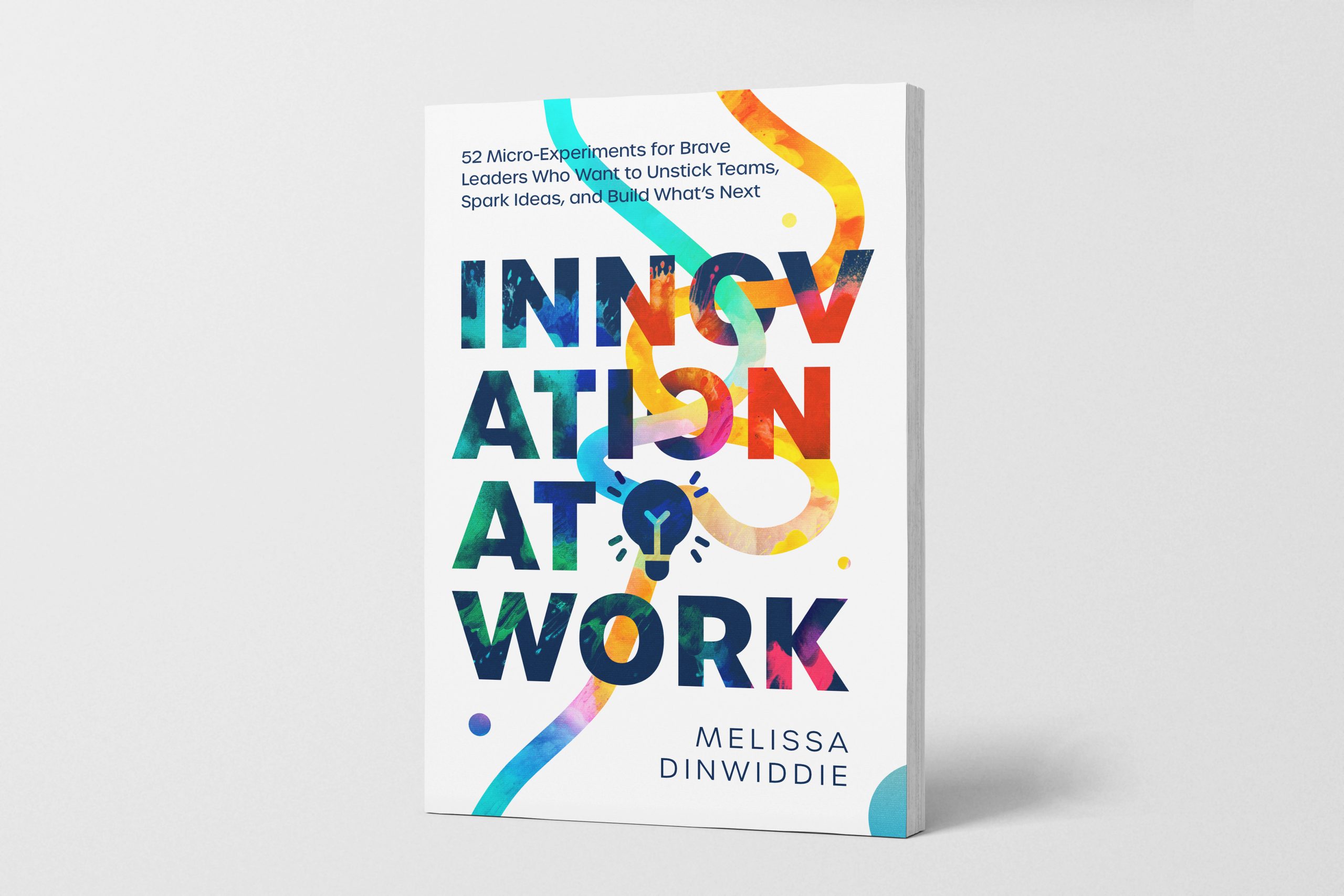
And if you want 52 structured experiments for giving your analytical team exactly this kind of permission — my book Innovation at Work is just 99 cents on Kindle through April 23. That’s not a typo. Grab it while it lasts. → innovationatworkbook.com/Amazon
P.S. I’ve been having a lot of conversations lately about what it actually looks and feels like to lead through genuine uncertainty — not the polished retrospective version, but the messy, human, in-the-middle-of-it version. Those are the conversations I want to keep having — and keep making possible. More on that very soon.