Click to watch (12:05) or scroll down to read more
Hey there, innovation champions!
Today I want to talk about something that is quietly killing innovation on your team.
It’s not a lack of ideas. It’s not the wrong tools or the wrong people.
It’s the unspoken rule that everything has to be good before anyone sees it.
Why Your Next Innovation Should Be Terrible (On Purpose)
Here’s what I know about analytical, high-performing teams: they don’t lack ideas. They lack permission to have bad ones.
And that distinction is everything.
The Canvas I Almost Threw Away
Years ago, back when I was a professional visual artist, I had a daily studio practice: create something, then post it to Instagram — finished piece or not.
It was uncomfortable. Deeply uncomfortable. But it was useful, because it forced me to stop waiting for “ready” and start doing the work.
One day I painted something I genuinely hated. I looked at it, cringed, and reminded myself: the goal is to create, not to be brilliant. So I snapped a photo, posted it with a mental note that I’d be painting over it the next day, and moved on.
Within hours, someone sent me a DM asking how much it would cost to buy it.
The piece I wanted to trash. The one I’d already mentally consigned to the garbage heap.
They wanted to buy it.
It was a genuine paradigm shift for me — a visceral reminder that “crappy” is often in the eye of the beholder. And that the voice telling me this is terrible, you should quit wasn’t a quality-control mechanism.
It was fear wearing a very convincing disguise.
What the Inner Critic Is Actually Saying
Here’s the reframe I’ve carried with me ever since:
When the inner critic says “this is terrible, you should quit” — that’s the signal to keep going.
Same with “it’s been done before.” Same with “who are you to do this thing?”
Those voices aren’t protecting quality. They’re protecting comfort. They’re trying to keep you exactly where you are, inside a familiar boundary where nothing new — and nothing risky — can happen.
I proved this to myself again when I wrote my first book, The Creative Sandbox Way™. Every chapter I wrote, those voices showed up. Every chapter, I had to make the same choice: listen to them, or ignore them and keep going.
I kept going. The book got written. (And I’ve lost track of the number of readers who have told me that book changed their lives!)
The voices didn’t stop. I just stopped obeying them.
This Isn’t Just an Artist Problem
When I shifted from my studio practice into working with corporate teams, I expected to find a different dynamic.
I didn’t.
What I found — at Meta, at PMI, at organizations full of engineers, researchers, and project managers — was the exact same pattern, just dressed in business casual.
Ideas that never made it out of someone’s head because they weren’t “ready.”
Decks that got polished for three weeks instead of tested in three days.
Brainstorming sessions where people offered only the safest, most defensible version of their thinking.
It’s perfectionism. And in analytical environments, it’s especially insidious — because it doesn’t feel like fear. It feels like discernment. Like rigor. Like exactly what you’d expect from smart, conscientious professionals.
But the result is the same: nothing moves.
What Actually Unlocks Teams
In my work with one research team — a group of people who were, by their own description, deeply skeptical that any “creativity workshop” could be relevant to them — I ran an exercise from my Communicating for Influence™ program.
Each participant practiced sharing a distilled version of their research with a room full of people playing wildly different roles: a kindergartner, a Fortune 500 CEO, a dentist. The audience was encouraged to really inhabit those personas — to ask the questions that person would ask, in the way they’d ask them.
The volunteer had to respond in real time. Iterate in real time. Try something, notice it wasn’t landing, adjust, try again.
Not every attempt worked. That was the whole point.
What I watched happen in that room was exactly what Make Crap is designed to produce: people discovering, through direct experience, that the first attempt doesn’t have to be the right one. It just has to be the first one.
The learning happened in the iteration. The confidence grew through the doing. And the team that walked out was visibly different from the one that walked in.
The Leader’s Role in All of This
Here’s what I want every senior leader reading this to understand:
You can talk about psychological safety all you want. You can put “we celebrate failure” on the wall and in the all-hands deck.
But if your team doesn’t actually believe there will be no consequences for making something bad — if they don’t see real, tangible benefits for taking creative risks — they won’t do it. Not really. They’ll play it safe and nod along.
The culture you want isn’t built through declarations. It’s built through demonstrated, repeated evidence that imperfection is genuinely okay here.
That means going first. Sharing your own half-formed thinking. Publicly naming when something you tried didn’t work. Rewarding the attempt, not just the outcome.
It means making Make Crap safe — not just in theory, but in practice.
The Make Crap Experiment to Try This Week
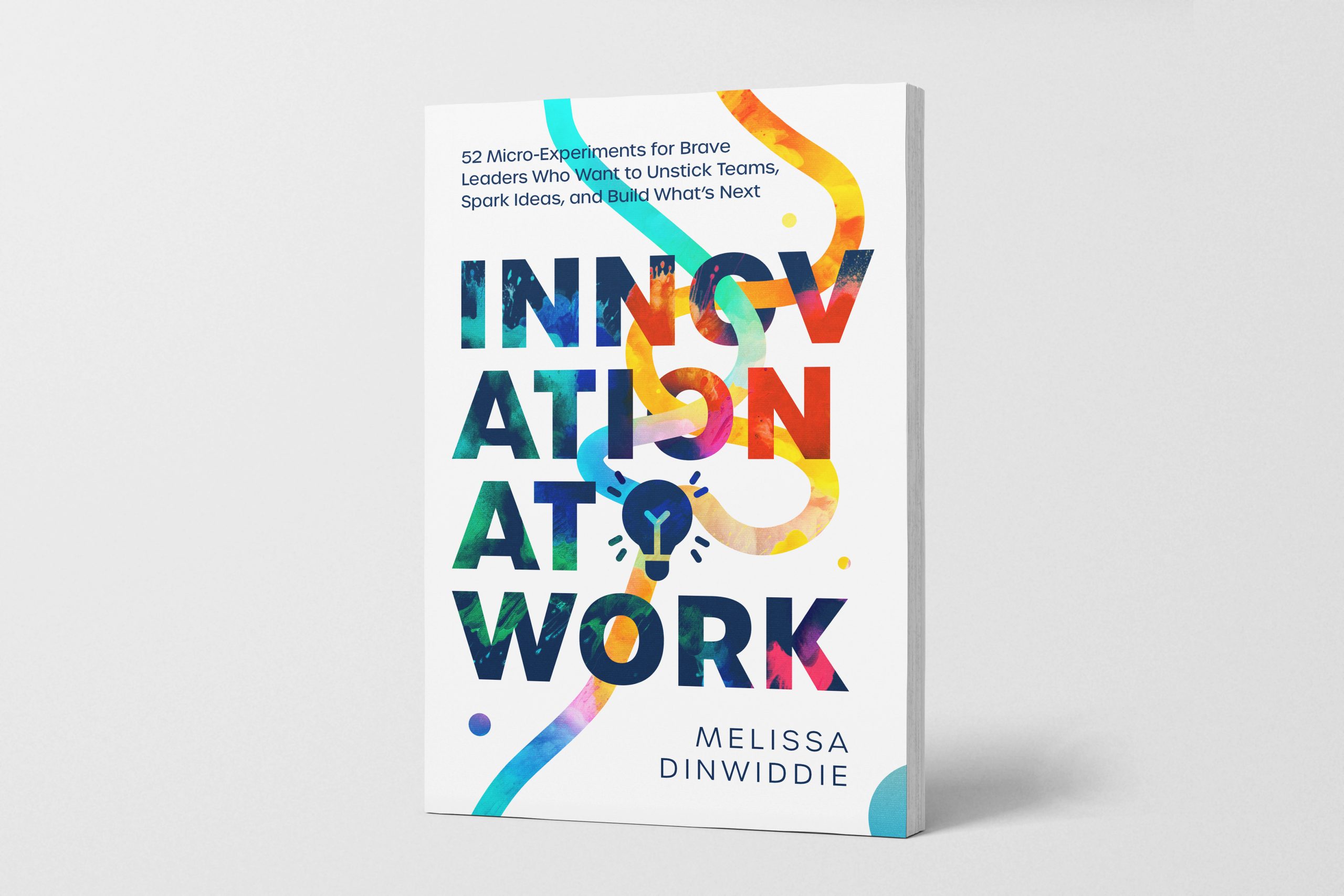
This is Experiment #1 from Innovation at Work — the Crappy First Draft Showcase.
Here’s how it works:
Set a 10-minute timer. Have each person on your team create a deliberately terrible first draft of a current work deliverable — a slide, a brief, a prototype, a wireframe. The goal is to make it intentionally bad: incomplete thoughts, rough sketches, placeholder text.
Then celebrate the crappiness in a brief show-and-tell.
That’s it.
What you’ll find: when the goal is to make something bad, the pressure to be perfect evaporates. People start. They generate. They iterate. And often — not always, but often — something genuinely useful surfaces from the mess.
Just like a painting someone wanted to buy that I almost painted over.
If this resonates, try the Crappy First Draft Showcase with your team this week — and click here to let me know what happened.
And if you want 51 more experiments just like it, Innovation at Work is waiting for you: innovationatworkbook.com/preview