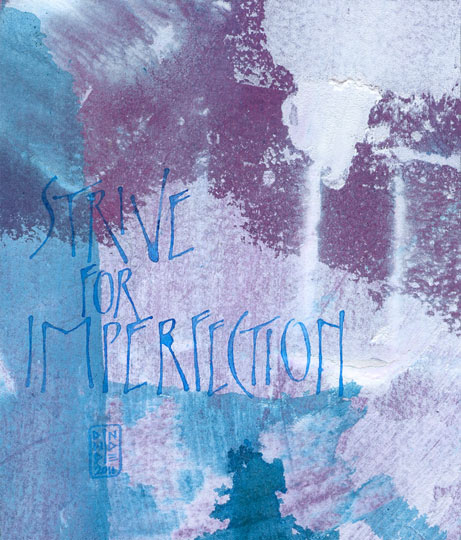
Ah, perfectionist paralysis — I know it well. It’s that belief that nothing I create is, or ever could be, good enough.
It’s what kept me NOT creating for decades.
And it’s epidemic!
If you’ve ever found yourself NOT creating, mired in resistance because your gremlins have convinced you that your writing/art/music/macaroni sculptures just weren’t good enough, this is for YOU. Read on…
Do you have a favorite musician, or writer or artist? Someone whose work touches you deeply, who moves and inspires you?
Maybe someone whose work got you through a tough time.
Or compelled you to think in a new way.
Or makes you smile as you pass it in the hall every day.
Or just jazzes you up when you need a little jazzing.
Now, let me ask you, how would your life be different – be lacking – without their creative contribution?
What if..?
Imagine that years ago, before you ever discovered her or him, this person whose work means so much to you decided it wasn’t good enough to share with the world, and kept it hidden.
Or worse, imagine that they became disgusted with their previous works and suddenly inherited the magical ability to disappear everything they’d ever created.
All the art (or music, or writing, or whatever) that had so touched you would instantaneously disintegrate, never to be partaken of again.
How does that make you feel?
I had the chance to experience that feeling in a profound way not too long ago. Just before heading home from music camp a few summers back, I got into a conversation with one of the teachers, a phenomenally skilled musician.
With a serious perfectionist streak.
This teacher’s command of multiple instruments is mind-boggling. This is one of those people who makes everything look effortless. Countless hours of dedicated practice have created not just technical proficiency, but exquisite expressive ability.
So it was a huge surprise to me when our conversation revealed a deep frustration underneath what, to me, was obvious talent and skill.
“I just don’t feel like I connect” was the astonishing confession, “my playing never matches what I want to express.”
And, most astonishing of all, “I’d really like to recall every single CD I ever produced.”
The very idea broke my heart.
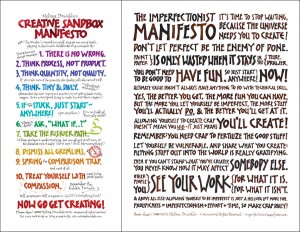 Get the Poster!
It’s a colorful, hand-lettered version of my Imperfectionist Manifesto, combined with my Creative Sandbox Manifesto, so you get two posters in one!
It’s ready for printing and posting on your wall where you can consult it daily (I sure do!) Just click the link to download:
The Creative Gap
Although I was astonished at this incredible musician’s flagellating self-judgment, I sympathized only too well with the concept.
I get it.
The fact is, there’s always a gap between what you want to produce – the Platonic Ideal that you have for your creative work – and what you’re able to create in reality.
This creative gap is at its most dramatic when you’re new at something, still honing your skills, working on your as-yet-nonexistent chops.
This American Life’s Ira Glass describes the creative gap very effectively in this little video excerpt:
The Beauty of Pursuit
What Ira doesn’t mention is that the gap is always there.
No matter how skilled you get, if you’re a creative person with taste, you are by definition always seeking to close that gap.
In truth, as long as it doesn’t stop us in our tracks, I think the gap is what keeps us driving forward. It’s the pursuit of mastery, rather than the achievement of it, that makes the whole thing interesting. (Click to tweet!)
Seriously, if you didn’t have something to work on and hone, wouldn’t you ultimately get kinda bored? I know I would. (Which explains why I tend to pick passions – calligraphy, jazz, songwriting, Argentine tango – that elude notions of “ultimate mastery”…)
The Imperfectionist Manifesto
Confession time: I’m a recovering perfectionist myself. My goal now is to be an imperfectionist, someone who takes imperfect action, rather than waiting for perfection (click to tweet!) – which is, after all, kind of like Waiting for Godot. Or Guffman.
Here’s what I’ve discovered – my in-process/imperfect Imperfectionist Manifesto:
Get the Poster!
• Even if you can’t stand what you’ve created, you never know how it may affect somebody else.
The musician I mentioned above is a case in point. I guarantee you the people who bought those CDs and witnessed those live performances had a very different feeling about the work than the musician’s flagellating self-judgment.
In my own life, it’s frequently the work that I feel less-than-satisfied with that gets the most positive response.
More than once I’ve posted a snapshot online of a painting that I was planning to paint over (because it was so crappy), only to have someone ask to buy it! (Go figure!)
I can imagine a couple of possible responses here:
- Assume that the person is bat-shit crazy.
- Open up to the possibility that their positive opinion may actually have some validity.
Trust me, choosing number 2 is a much happier way to live.
Instead of assuming that someone who likes my self-described “crappy” work is a nut with horrible taste, I float the possibility that their positive opinion may have some validity.
I still get to have my own opinion. I still get to feel crappy about my work if I want to, but rather than doubt my taste, I’ve learned to appreciate other people’s.
We may always disagree, and that’s okay, but I’ve had enough delighted responses to stuff I was tempted to trash to understand that something I think is “crap” may very well change someone else’s life for the better, even if only by making them smile.
• Ultimate value doesn’t always have anything to do with technical skill.
Recovering perfectionists such as myself have a hard time wrapping our heads around this one, but it’s true. Technique is great, but it’s sooooooooo not everything. (Um, Bob Dylan’s singing, anyone?)
At music camp that summer, one of the most entertaining acts in the student concert was a group of guys playing ukulele and singing who were not particularly technically skilled. (One of them had picked up the ukulele for the first time that week.) They felt sucky about the performance, even wished they hadn’t gone onstage at all. As an audience member, though, I found them utterly delightful.
One of the most memorable dance performances I ever saw was a man who was technically extremely limited, but a gripping performer. He didn’t do much more than walk, but I couldn’t take my eyes off of him. The acrobatic ballerinas in the ensemble didn’t compel me nearly as much.
My experiences of those evenings would have been much less enjoyable, and much less memorable, if those technically limited performances had never happened.
Plus guess what? Seeing those imperfect performers helped me feel a sense of permission that I could perform, too! What a gift!
Please, please don’t hide your creativity because you don’t feel your technique is up to snuff!
• Putting stuff out into the world is really gratifying, and can help you see it with more appreciative eyes.
Yes, it can be scary as hell, but human beings are social creatures. We’re wired to want to connect. Sharing what we create is one way we do that.
No, not everyone will like what you do. But the response that you get from people who do will nourish you and make you want to do more.
And here’s the really cool thing: when you share your creative work and start to get positive responses to it, it can help you see your work through other people’s (more neutral) eyes.
See, to paraphrase a calligraphy teacher of mine, Peter Thornton:
Other people see your work for what it is. YOU see your work for what it isn’t. (Click to tweet!)
You tend to only see where your work is lacking. Where it differs from the vision you had for it in your head.
But other people don’t have that point of comparison! All they see is what’s there, not what isn’t there.
When someone responds positively to what’s there, it helps me to take off my “gremlin glasses,” which color everything with the critical voices of my gremlins, and put on the neutral glasses of the viewer.
In other words, it helps me to see my work through their eyes, even as if I were looking at someone else’s work instead of my own.
In this way, sharing my imperfect work has enabled me to not only appreciate it more, but to have more compassion for my work, and for myself as its imperfect creator.
One caveat, though. It’s important to note that sharing your work to see it through other people’s eyes is different from sharing your work in an attempt to seek praise and validation.
I know your biggest fear is that people will judge you for your imperfect work, but if you can open up
• Allowing yourself to be imperfect is a helluva lot more fun.
Being a perfectionist is not a fun way to live. In fact, it’s really stressful. Imperfectionists are just more relaxed, happier, and generally a lot more fun to be around, too.
• The more you let yourself be imperfect, the more stuff you’ll actually do, and the better you’ll get at it.
Therein lies the irony.
Do you know the story about the college ceramics class? At the beginning of the term, the teacher divided them into two groups: all the students on one side of the classroom would be graded solely on the quality on their pots; all the students on the other side would be graded solely on the quantity.
It’s not surprising that the quantity group had acres more fun, chatting and laughing as they threw crappy pots one after another, while the quality group agonized on the other side of the room. But guess which group got better grades? Also the quantity group – they cranked out so many pots that they figured out through doing how to make good ones.
As Ira Glass says in the video above, the most important possible thing you can do is do a lot of work.
An invitation
Consider this post my personal invitation to you to join me in the ranks of the Imperfectionists.
Let’s create a movement of artists and creatives, committed to Imperfection at all costs.
Update 2/26/14: After realizing that the only reason I hadn’t expanded my Imperfectionist Manifesto into a poster was (wait for it..) perfectionism, I bit the bullet and got to work. Now my poster is available for purchase here, AND for free below!
Click the button to download a FREE printable version, with BOTH of my manifestos!
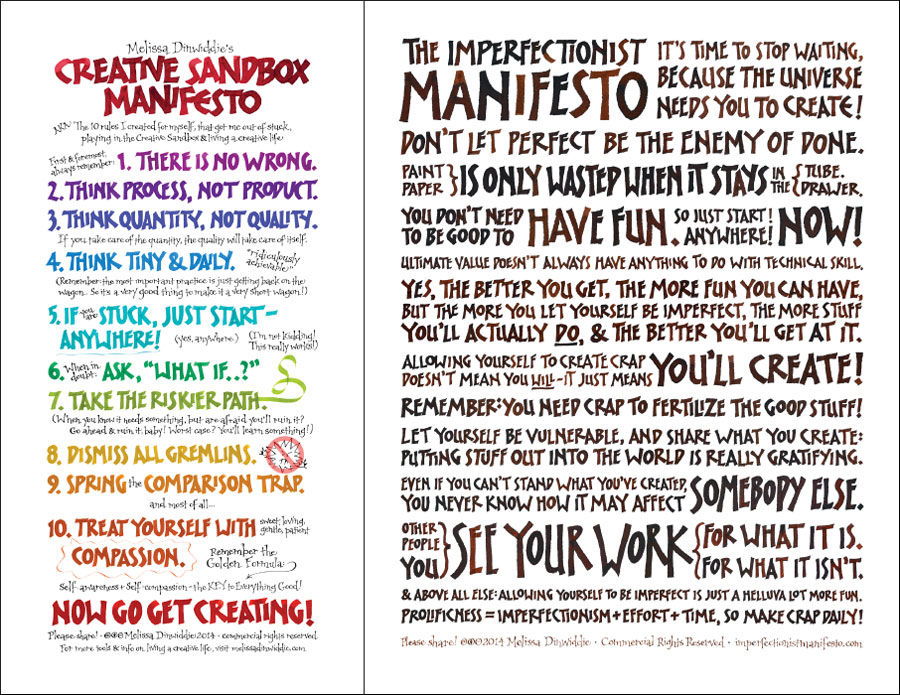
To see start-to-finish process pics, and read about the manifesto’s creation, click here. For a fine art print of the artwork above, visit my Zazzle shop.
How do you intend to commit to Imperfection? Is there anything you’d add to the Imperfectionist Manifesto?

PS — Pssst! Know someone who might benefit from seeing this today? Pass it on!
This post was originally published on 7/31/11.