Hey there, innovation champions!
Here’s the thing nobody tells you about innovation initiatives: most of them don’t fail because the idea was bad. They fail because everyone expected them to be perfect before they started.
Sound familiar?
I’ve been inside enough tech teams (heck, teams in general!) to know that this is one of the quietest innovation killers out there. Not the lack of smart people. Not the lack of good ideas. The insistence that every new approach needs to be bulletproof before it gets a chance to breathe.
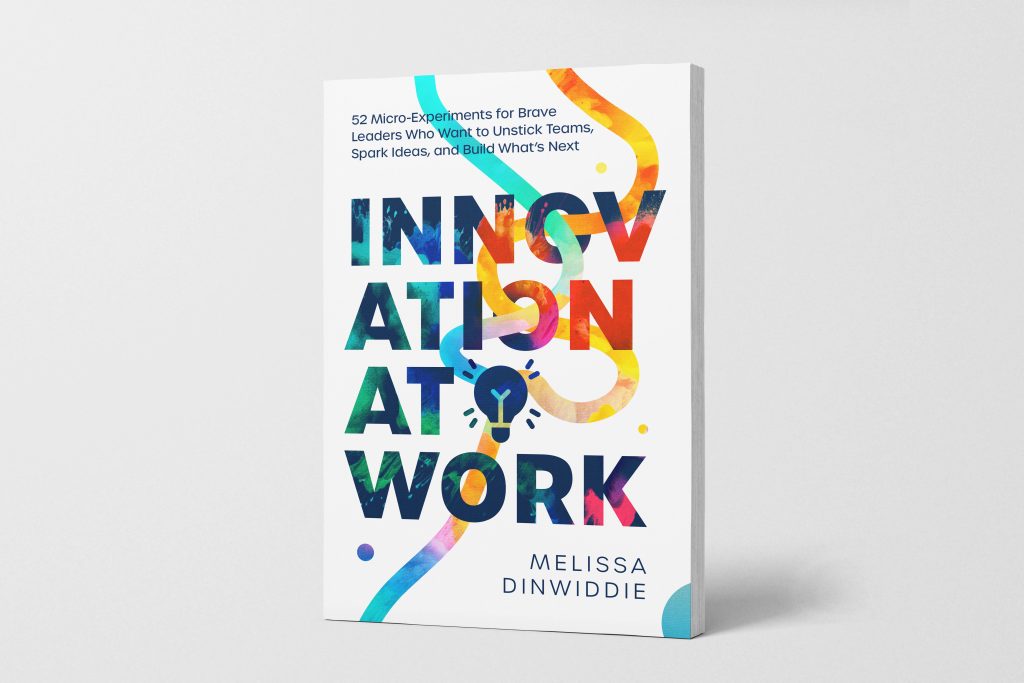
So when I sent out the Advance Reader Copy of my new book, Innovation at Work, on Monday — a book built around 52 micro-experiments I haven’t personally run with every possible team — I wasn’t nervous about it.
I was practicing what I teach.
The Night Half a Room Raised Their Hands
The first time I ran my Communicating for Influence workshop with a research team at Meta, everything was on Zoom. I’d worked with corporate tech teams before — including a workshop with Uber — but always in person. Running these kinds of activities virtually was completely new territory, and I had no idea how a Meta research team would respond to an improv exercise on a video call.
I knew something was landing partway through, but the moment I’ll never forget came during an activity called Time Traveler.
The setup: in pairs, one partner is from the present day, the other is a time traveler from 500 years ago. The present-day partner has two minutes to explain how a cell phone works — without their partner wanting to condemn them to burn at the stake for witchcraft. It’s an impossible task by design.
When we came back together, I polled the room: “How many witches in the room?”
Half the hands went up.
Then I asked the time travelers if anything their partner said actually worked. A few raised their hands. One shared that their partner had used an analogy based in something someone from the 1500s could relate to — and it clicked. We switched roles, and the present-day partner had to convince their time-traveling partner to put a broken finger into an x-ray machine. Fewer witches this time, but still plenty of challenge.
The activity itself? Completely unproven with this audience. I had no idea how a Meta research team would respond to an improv exercise on a Zoom call.
Here’s what happened next week: the team started using “Who’s the witch?” as shorthand. When someone on the team was struggling to communicate with a cross-functional colleague, they’d ask it — a playful way of saying are we speaking different languages right now? It became a tool they actually used, organically, because the experiment had given them both the language and the permission.
When the “Failed” Activity Became the Breakthrough
Not every experiment lands cleanly. And sometimes, the ones that don’t are the most valuable.
At a day-long retreat with a nonprofit team, I ran an activity I’d designed specifically for them. It wasn’t working. About three-quarters of the way through, one of the team members raised her hand and said, plainly, that she wasn’t getting anything out of it.
In that moment, I had a choice: power through the planned agenda, or follow what was actually happening in the room.
I followed the room.
What unfolded was a 45-minute conversation — completely unscripted, completely unplanned — that turned out to be the conversation this team had needed to have for months. I scrapped two activities I’d planned. The “failed” experiment had cracked something open, and the breakthrough didn’t come from the activity. It came from what the activity made possible.
Why Imperfect Experiments Beat Perfect Plans
Here’s the pattern I keep seeing, across Meta research teams and nonprofit retreats and PMI conferences and everywhere else I’ve worked: the teams that move fastest aren’t the ones with the best plans. They’re the ones willing to run the experiment and see what actually happens.
The Meta team didn’t need a perfect activity. They needed one that was good enough to spark something real — and then they needed the space to take it somewhere I never could have predicted.
The nonprofit team didn’t need an activity that worked. They needed one that failed in exactly the right way to open a door.
This is why I’m not losing sleep over the fact that Innovation at Work contains 52 experiments I haven’t personally facilitated with every kind of team in every kind of organization. Some of them I’ve used directly with clients. Others are synthesized from proven practices in innovation, improv, and creative problem-solving — curated and organized within my Create the Impossible™ framework, but not all personally field-tested with every possible audience.
The book is designed to evolve. I want to know how these experiments work when your team runs them. What surprises you. What doesn’t land. What you’d tweak.
Because that’s not a weakness in the book. That’s the entire point of the book.
What This Means for Your Team
If you’ve tried an innovation initiative before — and it didn’t stick — I’d gently push back on the assumption that the initiative itself was the problem.
More likely, the expectation was wrong. We set up innovation programs as if they should produce polished results on Day One. As if the first experiment needs to be the final product.
But innovation doesn’t work that way. It works the way that Meta research team stumbled into “Who’s the witch?” — through an imperfect experiment that created something nobody could have designed in advance.
The question isn’t whether your team’s next experiment will be perfect. It won’t be.
The question is whether you’re creating conditions where imperfect experiments are allowed to happen — and where what emerges from them actually gets used.
If You’re Thinking About What This Could Look Like
If you’re a leader who’s been thinking about how to build genuine innovation capability in your organization — not a one-off workshop, but the kind of systematic, ongoing experimentation that actually changes how people work — I’d love to explore what that could look like for your specific team.
Not a sales pitch. Just a conversation about where you are and what might actually move the needle.
Book an Innovation Strategy Session →
It’s 30 minutes, no strings, and no deck. Just us figuring out what’s possible.
And if you’re ready to start building innovation muscles the way you’d build muscles in a gym — one experiment at a time, consistently — grab a preview of Innovation at Work:
Or if you want the whole book before it’s available to the public — in exchange for an honest review — you can still join the Launch Team:
Next week: a peek inside Innovation at Work, and how to use the book.